Upgrade of let-it-snow to compute the fractional snow cover

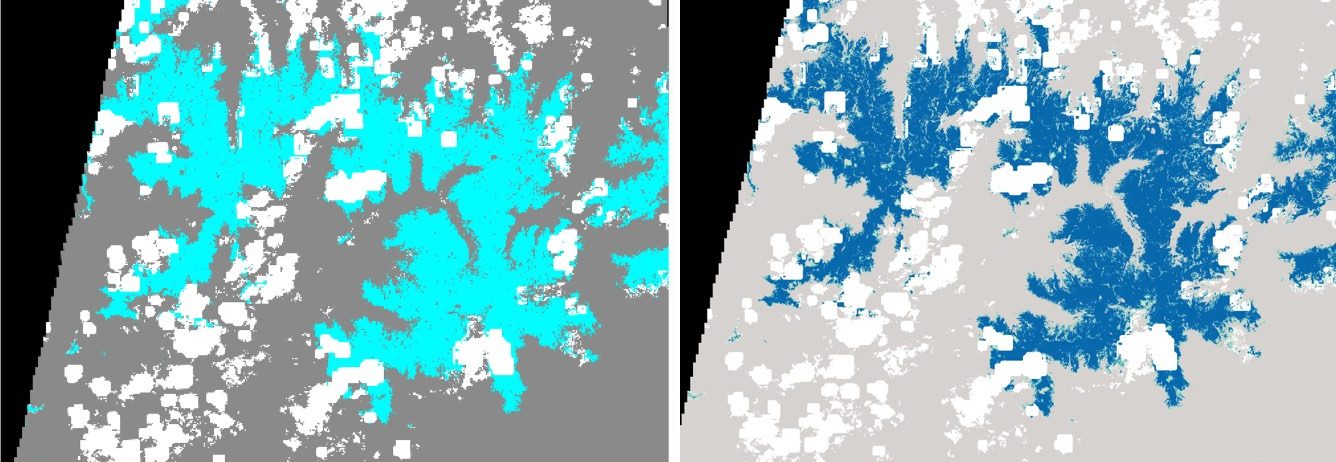
In preparation for the next Pan European high resolution snow and ice monitoring service, I have upgraded the let-it-snow (LIS) processor to enable the computation of the fractional snow cover (FSC) within the pixel.
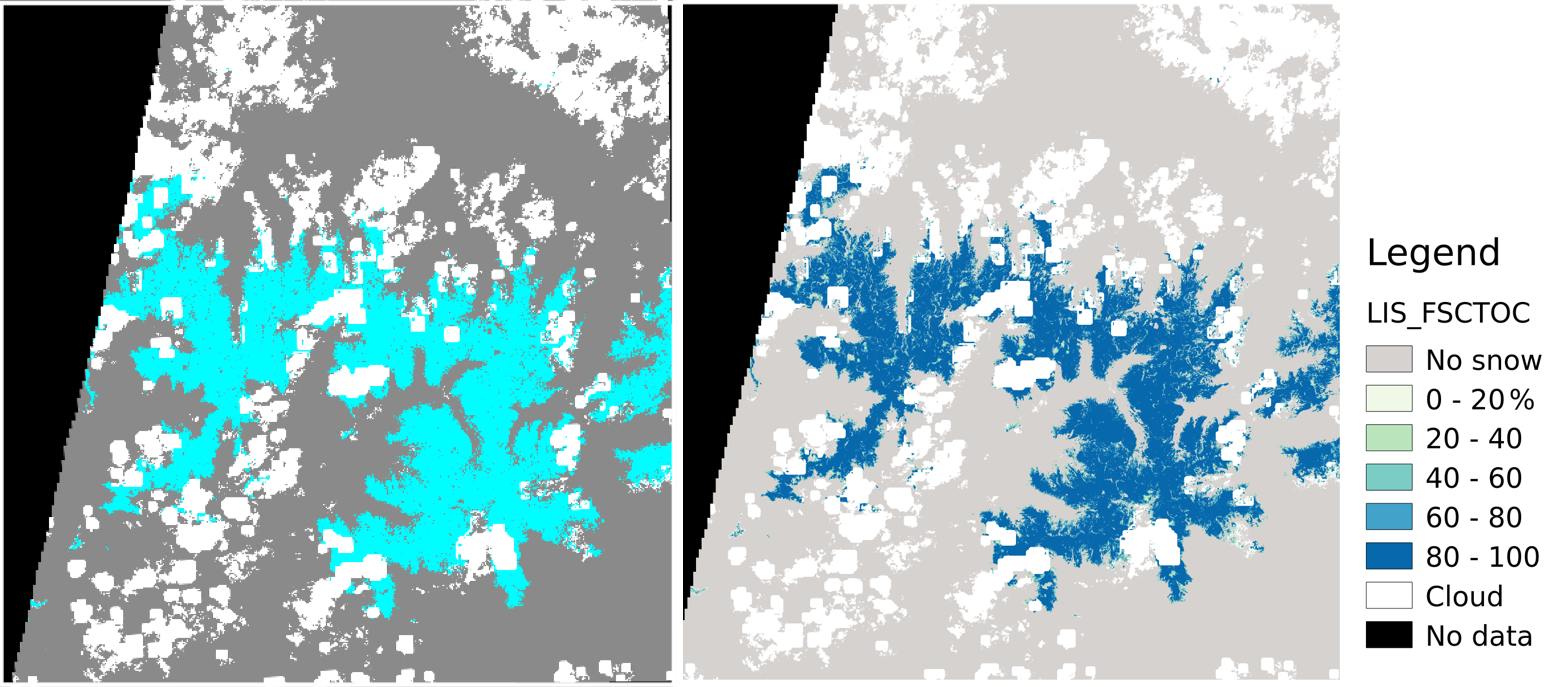
Binary vs. fractional snow cover in the Pyrenees (tile T31TCH on 12 June 2019). Here the FSC was computed using the MOD10A1.005 equation (SCF=−0.01+1.45×NDSI) by Hall et al. (2001). Source of the binary product: Theia.

So far LIS was only used to compute a « binary snow mask » (in fact ternary: snow, no-snow, cloud). However, the EEA requested that the service provides the snow fraction in every 20 m Sentinel-2 pixel. The EEA also specified that the FSC should be computed from the Normalized Difference Snow Index. Hence, the latest version of the LIS processor (currently in the develop branch) can now read a custom function in the configuration file to compute the FSC from the NDSI (see this template).

In forest areas, the function f(NDSI) provides a “top-of-canopy” FSC (FSCTOC), which can be adjusted based on the tree cover density (TCD) to estimate the “on-ground” FSC (FSCOG) (Raleigh et al., 2013).

$$FSC_{OG} = FSC_{TOC} / (1-TCD)$$
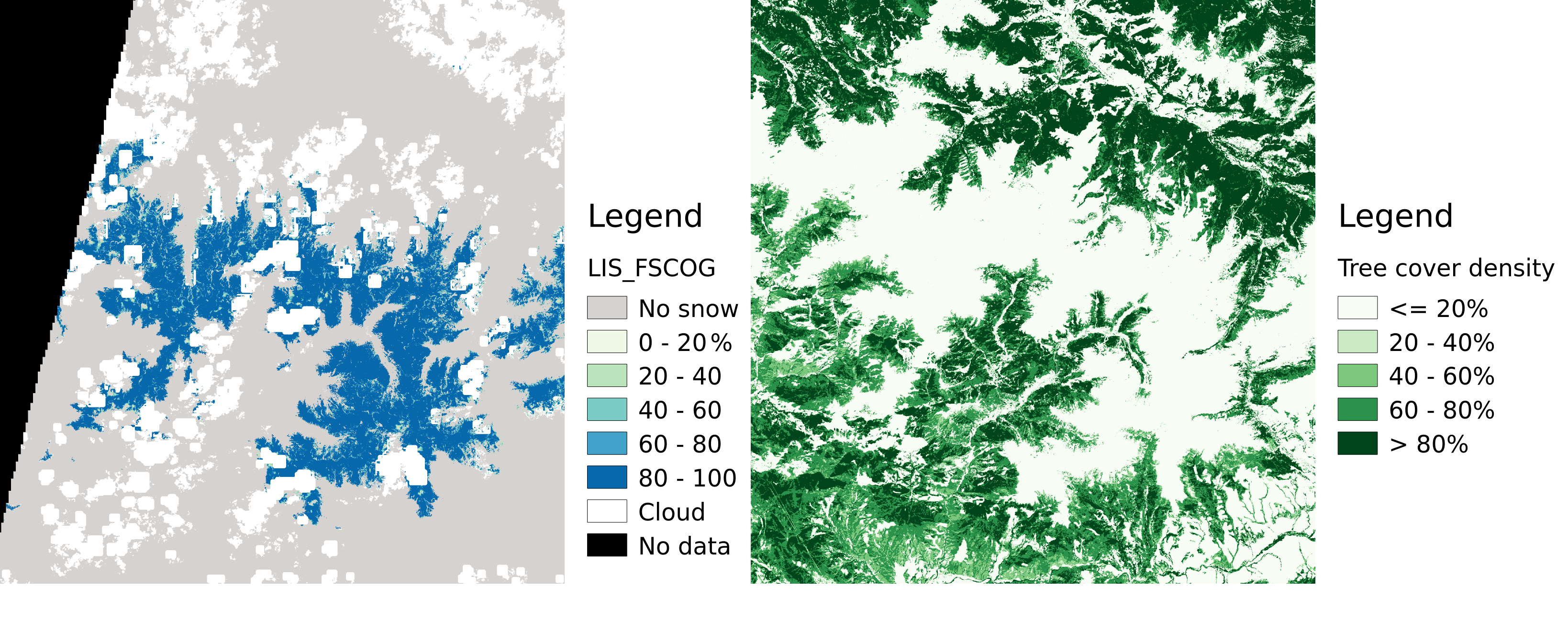
« On ground » snow fraction computed with LIS (Sentinel-2 on 2019-06-12 tile T31TCH)

The TCD is given at 20 m resolution by the Copernicus High Resolution Layer Tree Cover Density status map (current release is 2015). The example below illustrates how this correction increased the snow fraction near the edges of the snow cover area, where the forest partially masked the snow cover.
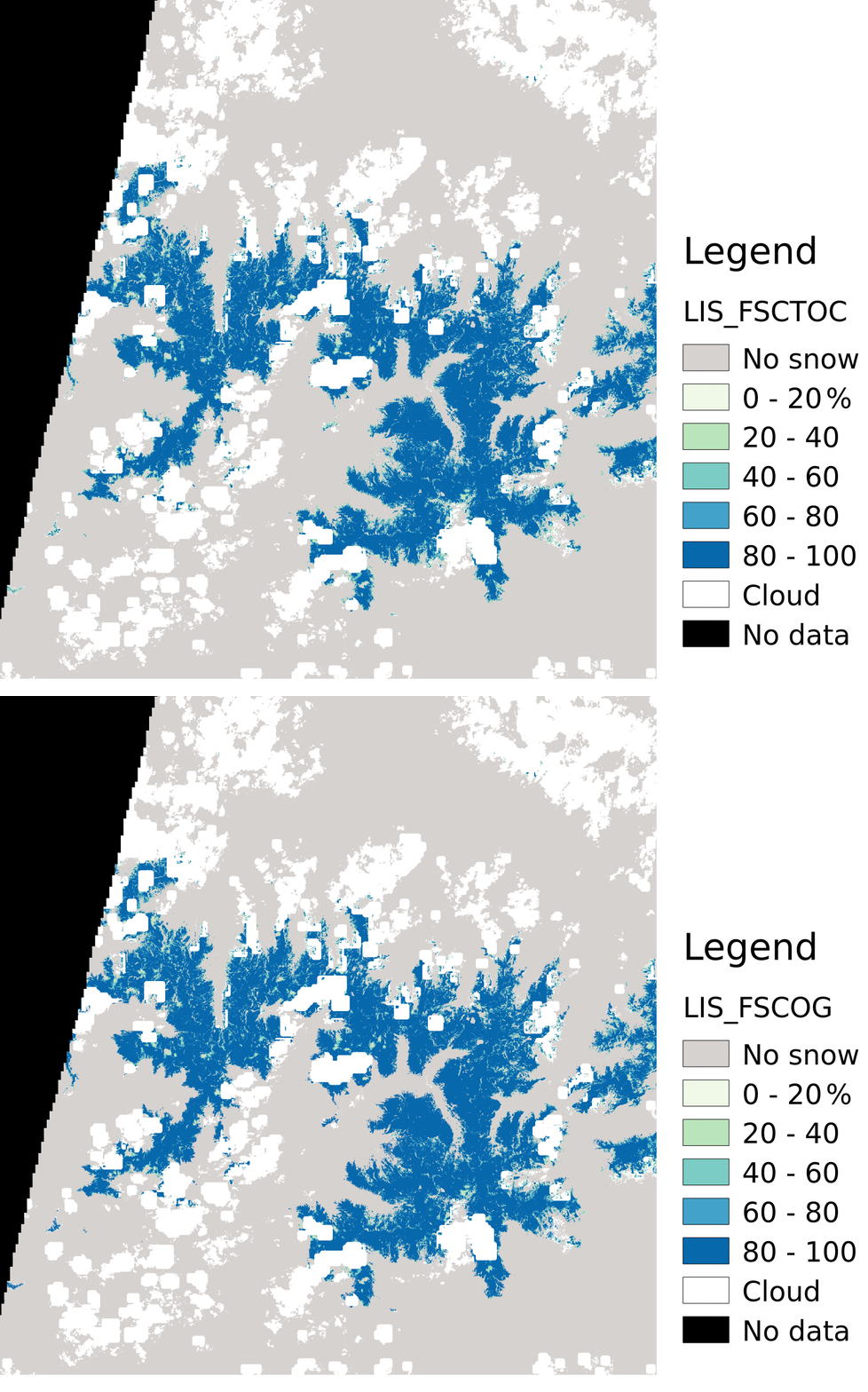
Snow fraction: top-of-canopy vs. on-ground


We will now focus on the calibration of the FSC=f(NDSI) function using ground truth data (read this if you’re interested in contributing!).

Plus d'actualités

Near real time snow cover maps in the Copernicus Browser!

Copernicus provides near real time snow cover maps at 20 m resolution (fractional snow cover, code name: FSC OG). These products have been recently reprocessed and are now available through the Copernicus Data Space Ecosystem (CDSE) API and visualization tool, the Copernicus Browser! The latter is very useful to explore the data, for example if […]

Suivi du manteau neigeux dans les parcs naturels des Alpes franco-italiennes

Dans les Alpes, le manteau neigeux est un stock d’eau saisonnier naturel dont dépendent la faune, la flore et les humains pour de multiples usages (refuges, bétail, etc.). Dans le cadre du projet ACLIMO financé par le programme européen Interreg ALCOTRA, le Cesbio a été sollicité pour mettre en oeuvre un outil d’estimation de l’équivalent […]

The missing link to valorize CESBIO’s applicative research works

=>  My colleagues at CESBIO are extremely creative! Over the past ten years, they have developed a wide range of new products and methods for extracting information from Copernicus data. They don’t just develop and validate the method on a few sites; they continue their work until they have produced data for the whole of […]

Rechercher