Sentinel-2 reveals the surface deformation after the 2025 Myanmar earthquake
Sentinel-2 captured several clear-sky images of Myanmar before and after the 28 March 2025 earthquake. The animation below shows a 5-day apart sequence of images captured by Sentinel-2B and Sentinel-2C (10 m resolution) near the epicenter located close to Mandalay.
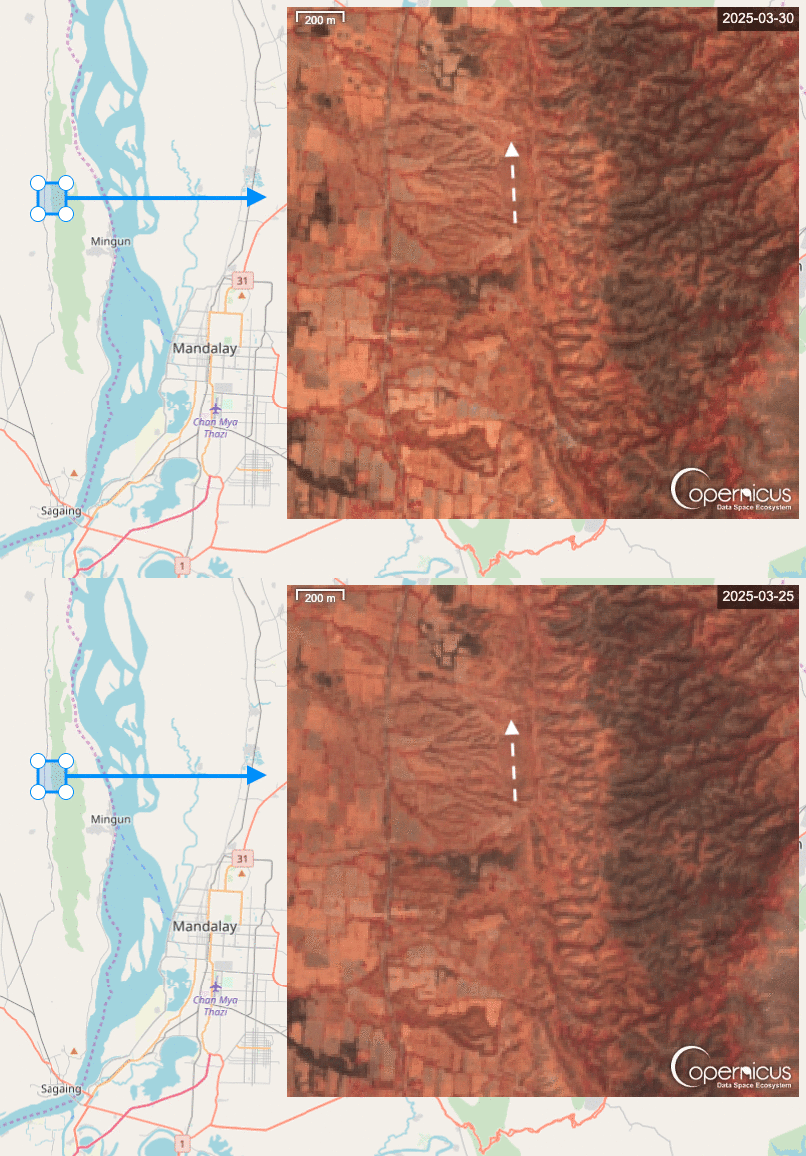
The surface slip due to the earthquake follows the Sagaing Fault, a major fault in Myanmar, and extends over 500 km (!) according to Bradley and Hubbard. They used Sentinel-1 and Sentinel-2 to map the offsets but the method is not explained and their results look a bit different than another analysis posted by Zixin Lee using Sentinel-2.
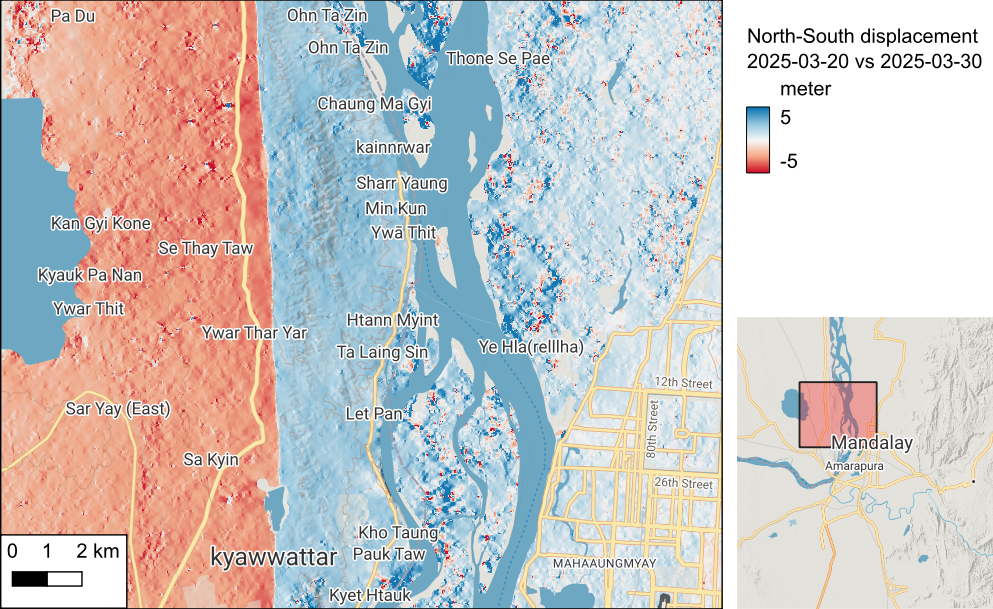
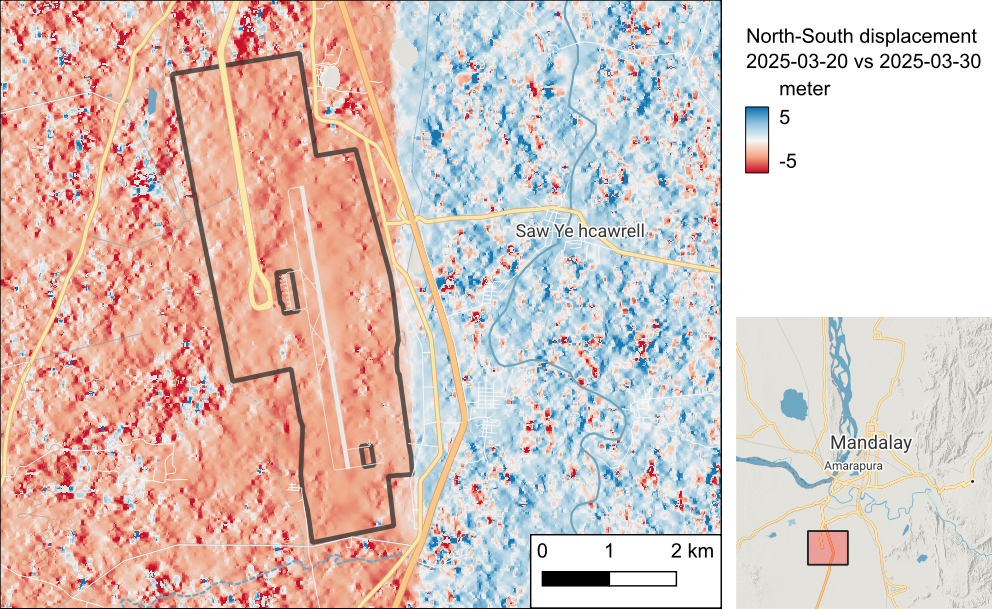
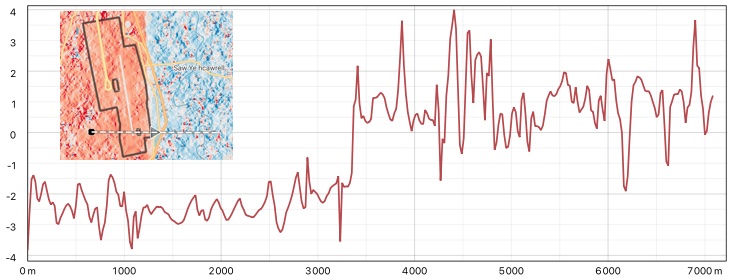
This prompted me to perform my own analysis. I selected the pair of Sentinel-2B images acquired on 20 and 30 March 2025 (same sensor, same orbit, same acquisition geometry) near Mandalay. I used the MicMac software through the online GDM-OPT service with default parameters (band B04, window size 5×5, correlation threshold 0.2). The output shows a very sharp surface slip in the north-south direction.
Thanks to ESA (and Olivier), Sentinel-2 is a now a constellation of three satellites, which enhances the availability of Sentinel-2 observations.
Data available here: Ground surface displacement maps of the 2025 Myanmar earthquake [Data set]. Zenodo. https://doi.org/10.5281/zenodo.15127866
Update on 03 April 2025: Other more extensive analyses were posted by Max Van Wyk de Vries and by Floriane Provost.