
Vavilov Glacier in 2016 and 2017

The organizers of the 2017 International Glaciology Society meeting in Boulder tweeted this animation of the Vavilov Glacier (October Revolution Island, Russian Arctic):

I tweeted a similar animation using only Sentinel-2 imagery for the years 2016 and 2017:


Of course the Sentinel-2 record is too short to say anything about the long term evolution of the glacier. However we can spot some differences between both years. In August 2017 the glacier front is still more advanced than it was last year in July. Also, in 2016 the sea ice started to unlock the glacier tongue earlier than it did in 2017. This is consistent with the fact that in May-June 2016, Arctic sea ice reached a record low. It can be seen using the interactive sea ice graph that the Arctic sea ice extent in 2017 was not as low as it was in 2016:
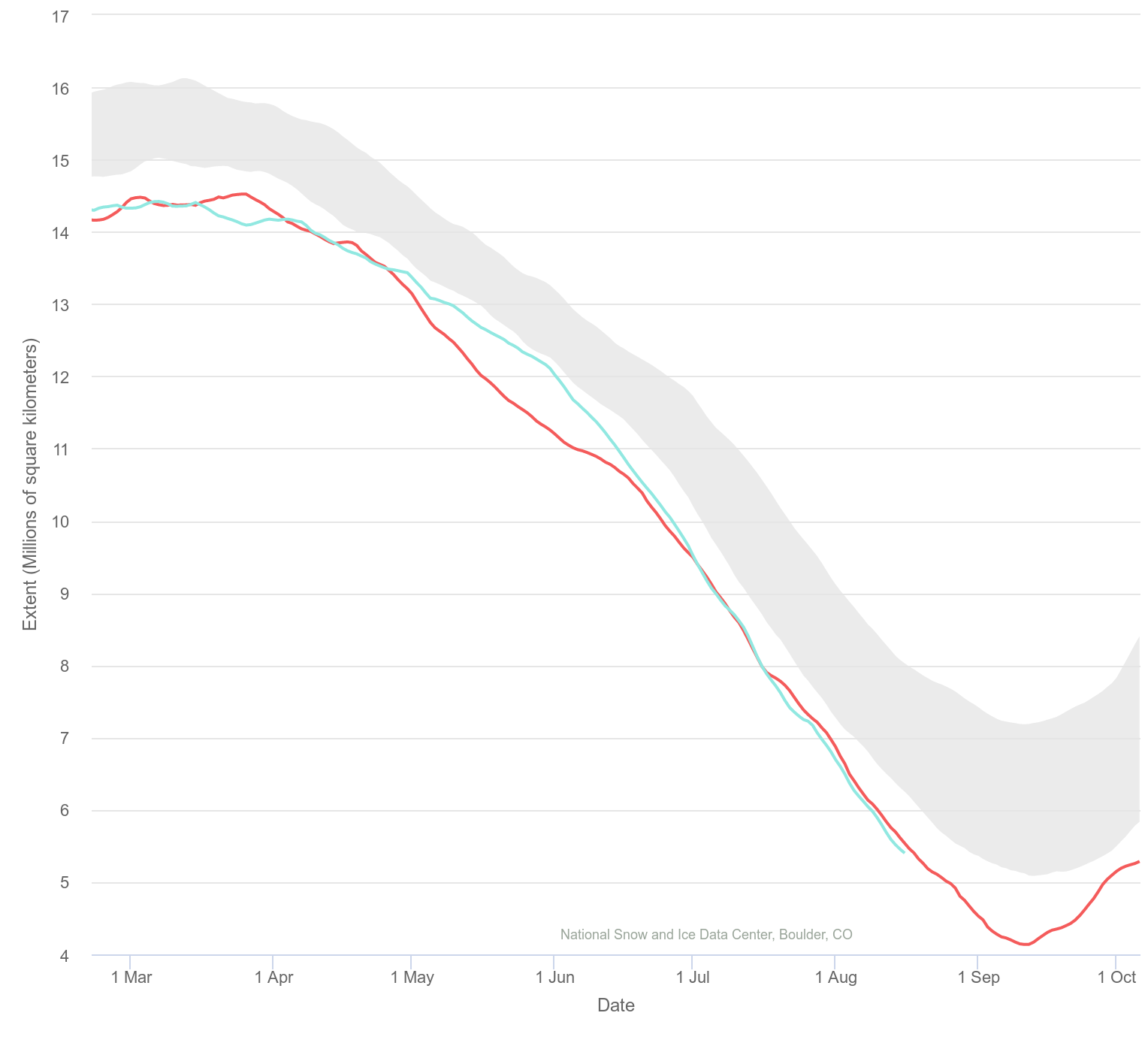
Arctic sea ice extent in 2016 (red) and 2017 (blue). The shaded area is the 1981-2010 interdecile range.

I wonder if the rapid ablation of the Vavilov glacier front in 2016 is related to the early ice free conditions!

edit on Sep 2018: Sentinel-1 animation

Plus d'actualités

Near real time snow cover maps in the Copernicus Browser!

Copernicus provides near real time snow cover maps at 20 m resolution (fractional snow cover, code name: FSC OG). These products have been recently reprocessed and are now available through the Copernicus Data Space Ecosystem (CDSE) API and visualization tool, the Copernicus Browser! The latter is very useful to explore the data, for example if […]

Suivi du manteau neigeux dans les parcs naturels des Alpes franco-italiennes

Dans les Alpes, le manteau neigeux est un stock d’eau saisonnier naturel dont dépendent la faune, la flore et les humains pour de multiples usages (refuges, bétail, etc.). Dans le cadre du projet ACLIMO financé par le programme européen Interreg ALCOTRA, le Cesbio a été sollicité pour mettre en oeuvre un outil d’estimation de l’équivalent […]

The missing link to valorize CESBIO’s applicative research works

=>  My colleagues at CESBIO are extremely creative! Over the past ten years, they have developed a wide range of new products and methods for extracting information from Copernicus data. They don’t just develop and validate the method on a few sites; they continue their work until they have produced data for the whole of […]

Rechercher