Combined exploitation of VENμS, Sentinel-2 and Landsat-8: the spectral bands

=>

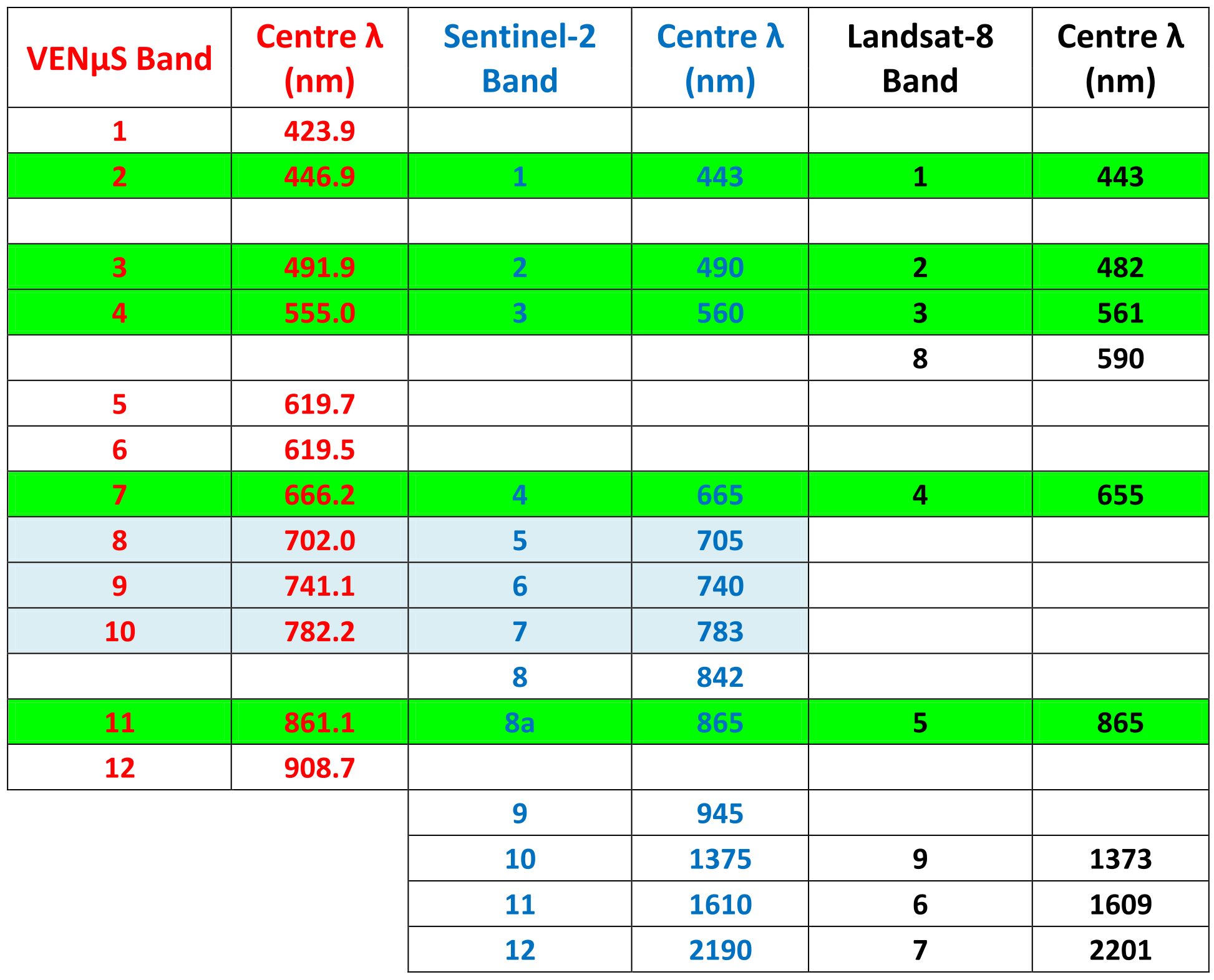
The combined use of VENμS, Sentinel-2 and Landsat-8 data can increase the likelihood of obtaining cloud-free images or may allow detailed tracking of rapidly evolving phenomena. In order to facilitate this combination, the table below summarizes the correspondences between the spectral bands of the instruments. VENμS does not have a spectral band in the middle infrared.
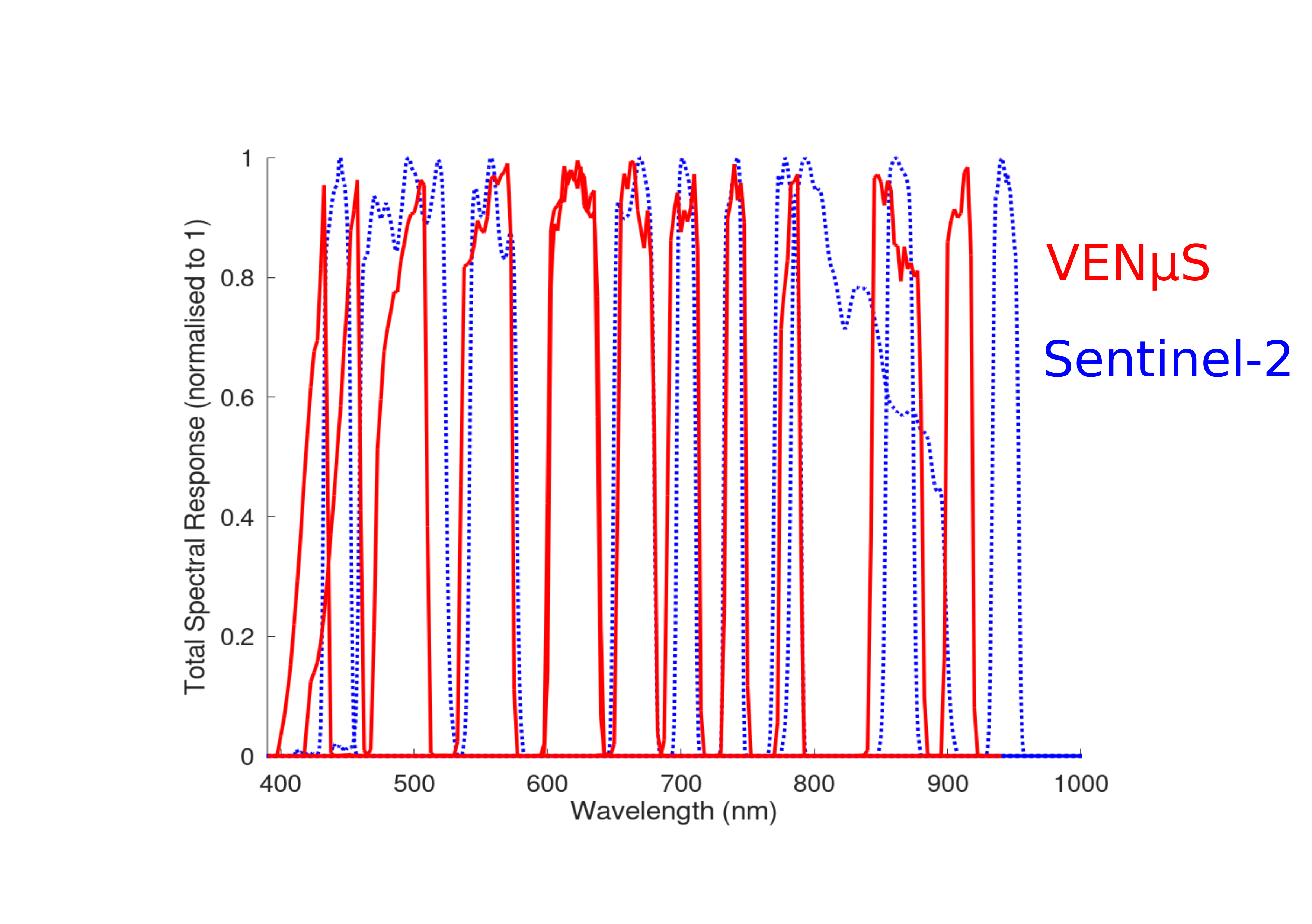
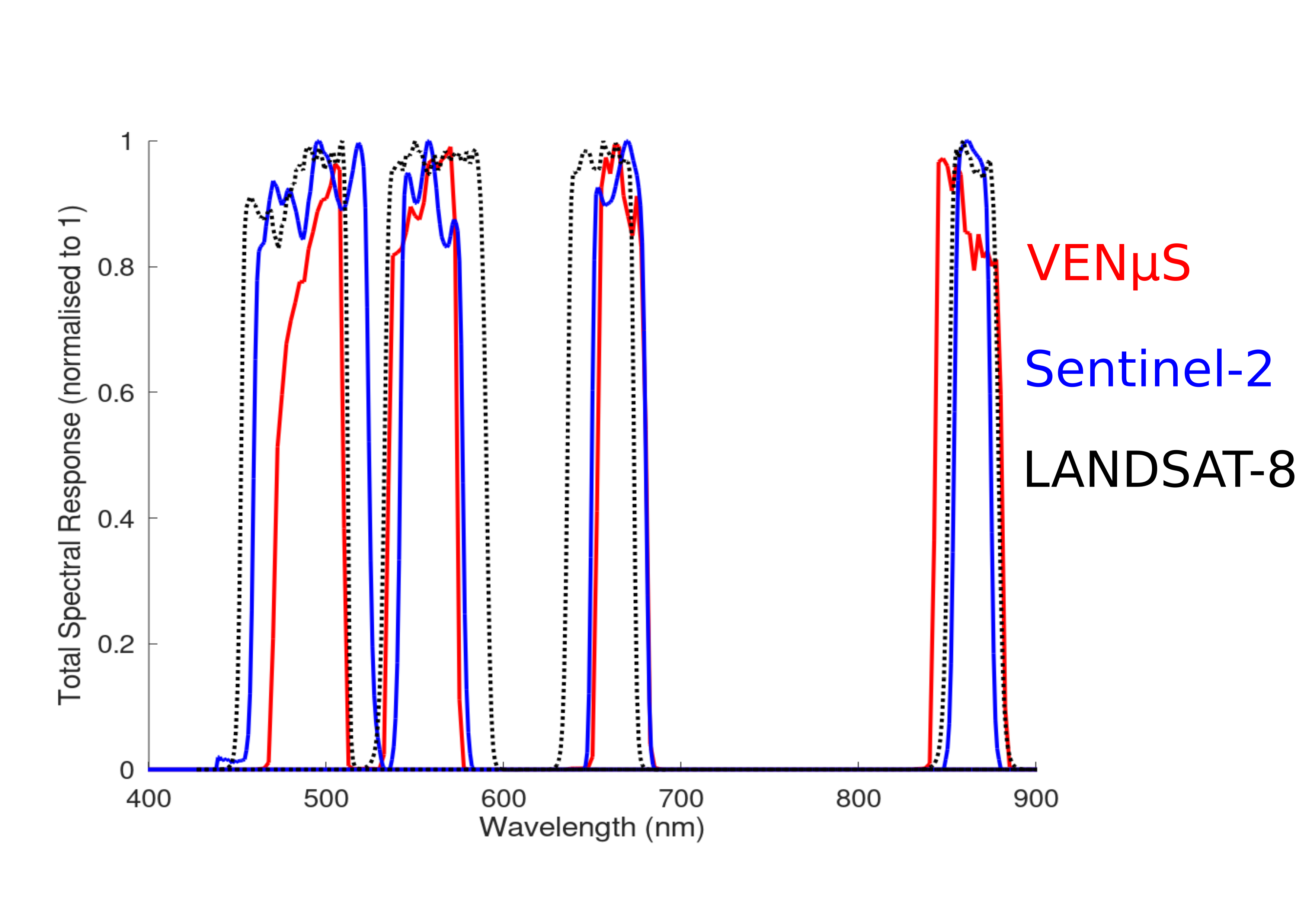
The figure below shows the spectral bands of VENμS and Sentinel-2 in the 400 to 1000 nm range. The SWIR bands of Sentinel-2 are not included.
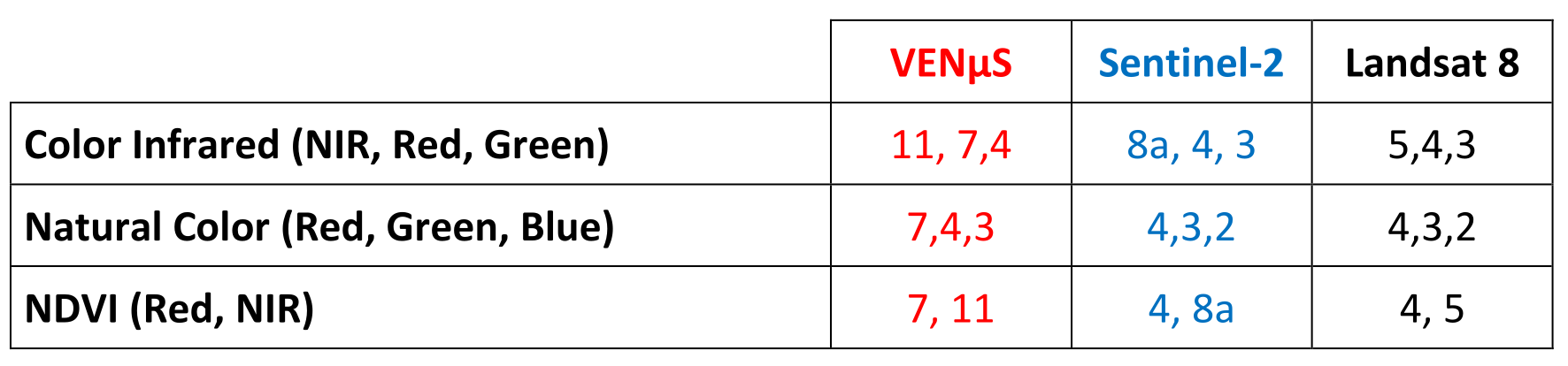
The table below shows the usual band combinations
 

The figure below makes it possible to assess the degree of similarity of the spectral responses of these usual bands.
The detailed spectral responses of each instrument are available via the following web pages:

VENµS https://www.cesbio.cnrs.fr/multitemp/?page_id=14229

SENTINEL-2 https://earth.esa.int/web/sentinel/user-guides/sentinel-2-msi/document-library/-/asset_publisher/Wk0TKajiISaR/content/sentinel-2a-spectral-responses

LANDSAT https://landsat.usgs.gov/spectral-characteristics-viewerhttps://landsat.usgs.gov/landsat/spectral_viewer/bands/Ball_BA_RSR.xlsx


Plus d'actualités

Impact of the August 12, 2026 eclipse on photovoltaic electricity generation in Spain

Photovoltaic (PV) energy supplies more 20% of Spain’s total electricity, and this share hit a new high in July 2026 (28.3% of the nation’s monthly electricity mix). Some media outlets were concerned about the drop in photovoltaic power generation during the 12-Aug-2026 eclipse. Le Monde explained that « the drop is expected to be particularly pronounced […]

Near real time snow cover maps in the Copernicus Browser!

Copernicus provides near real time snow cover maps at 20 m resolution (fractional snow cover, code name: FSC OG). These products have been recently reprocessed and are now available through the Copernicus Data Space Ecosystem (CDSE) API and visualization tool, the Copernicus Browser! The latter is very useful to explore the data, for example if […]

The missing link to valorize CESBIO’s applicative research works

=>  My colleagues at CESBIO are extremely creative! Over the past ten years, they have developed a wide range of new products and methods for extracting information from Copernicus data. They don’t just develop and validate the method on a few sites; they continue their work until they have produced data for the whole of […]

Rechercher