In English

The pros and cons of systematic global processing

=>  As the resolution of our satellite missions improve, the data volume of output products increases, and the share of the computing and storage costs of its products increases too. Let’s assume we are preparing a new satellite mission, for instance a Sentinel-like mission, with the hope of potential use by operational or private users, […]

04.10.2023

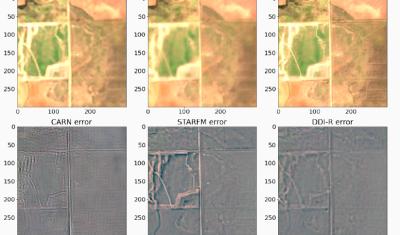
Test of spatio-temporal fusion of Sentinel-2 New Generation data with a potential VHR mission

Three years ago, we started the phase-0 study of a mission named Sentinel-HR : S-HR would be a satellite mission to complement Sentinel-2 new generation (S2-NG) with In that study, one of our assumptions was that a lower revisit frequency than that of Sentinel-2 was sufficient. This seems possible because, in most cases, the high frequency […]

28.09.2023

The rabbit of Alice in Wonderland is late, showing a big clock

[MUSCATE & THEIA] Production of Sentinel-2 L2A is late

Update on 25 september 2023 : we have no backlog left in Europe, and the system is catching up on the other regions of the world Update on 9 september 2023 : 25 days processed in a week over France ! We are catching up a bit CNES has bought and built a new HPC […]

05.09.2023

HR TIR DA IRL (High Resolution Thermal Infra-Red Directional Anisotropy In Real Life)

=>  In the frame of the preparation of the Trishna mission, one important question is : do we have to correct for directional effects, and how should we do it ? Some of you may be familiar with the so-called hotspot effect in the reflective domain, which is well illustrated on our blog. Well in […]

01.09.2023

Global map of irrigated areas

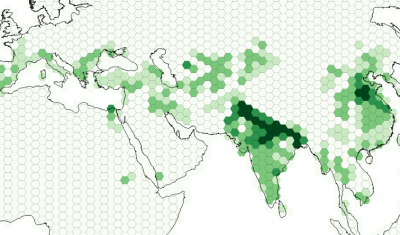
It’s not easy to find a good cartographic representation of the global irrigated land, therefore I made my own map using data from Meier et al. (2018). The raw resolution of the above product is 30 arcsec, i.e. 1 pixel covers about 1 km by 1 km at equator. Here, I aim to represent the […]

01.08.2023

An update on the use of CAMS 48r1

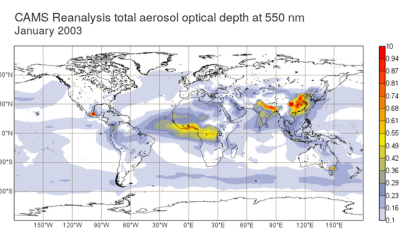
As announced in a previous post, the aerosol definition of the new 48r1 release of the CAMS auxiliary data has changed as compared to the former 47r1. At that time, we recommended to disable the use of CAMS data with MAJA before we adapt the code. Meanwhile, we have also tested the actual impact on […]

20.07.2023

Hesperides, the data garden

=>  Since a few years, my colleagues from THEIA project and from the data campus at CNES, started designing a new processing and distribution center, named Hysope-II. This centre was initially set up for products related to hydrology. It includes a processing center, a catalog, and a distribution center (hydroweb.next). It was developed in the […]

05.07.2023

MAJA and the new CAMS aerosols 48r1

The Copernicus Atmospheric Monitoring Service (CAMS) is about to release a new version of its aerosol products on 27 June 2023, referred as 48r1. Their evolution has a direct impact on MAJA, and requires us to adapt the processor. MAJA will not be ready to support 48r1 before the next MAJA release scheduled for September […]

22.06.2023

Reappearance of the Dnieper river after the destruction of Kakhovka dam

The Kakhovka Reservoir was created in 1956. As the level of the reservoir drops at a staggering rate of two meters per day, it is now possible to see the ancient river reappear in satellite images. I have georeferenced a 1943 German military map published by Defense Express in their article « 1943 Maps Show What […]

19.06.2023

Rechercher