
2015
 =>
=>  Dear reader, may 2015 bring you health and happyness !2015 should be a great year for the time series of optical images at a high resolution, with the launch of Sentinel 2A in Mat, in less than four months ! We have been waiting for it for so long that we can hardly believe it will be launched so soon. And to help you wait until then. SPOT5 orbit will be changed, to observe a hundred of sites with a 5 day repetitivity similar to that of Sentinel-2, until the end of August. This post is also an opportunity to recall what was achieved in 2014 :
- In February, we started the Sen2Agri project for l’ESA, with our partners, UCL, CS-SI France and CS-SI Romania. This project which is keeping us busy busy aims at producing a system for automatic classification of crops at the scale of whole countries.
- In March, THEIA released a new version of SPOT4 (Take5) data, in particular with an enhanced geometrical superposition. This data set has now been downloaded by more than 600 users.
- In May, the production in near real time (with a delay of 15 to 20 days) of LANDSAT 8 L2A products over France started (this type of product is still not available at USGS, but not for long, I guess…), followed by the processing of de 3 years of LANDSAT 5 & 7 data. 5 years of data, from 2009 to 2014, with an interruption in 2012, after LANDSAT 5 end of life and before LANDSAT 8 launch.
- In September, CNES finally decided to launch SPOT5 (Take5) experiment, thanks to a large contribution from ESA. The call for sites proposal was launched by ESA in November, and was largely successful, with 62 proposals for a hundred of sites. The analysis of this proposal is now on-going, and the choice will be difficult as the proposed applications are rich and very diverse.
- In September too, CESBIO hosted the meeting of THEIA Scientific Expertise Centres, which allowed to identify about 20 products that the centre could prepare in the coming years. These products are described in the recent THEIA bulletin (in French).
- In November, CNES hosted the SPOT4 (Take5) users meeting, to summarize data use, with a hundred of participants and 23 excellent presentations of the applications allowed by the experiment.
- In December, we finally launched the call for sites proposal for Venµs mission, which will be launched in 2016. The deadline is January the 28th, 2015.
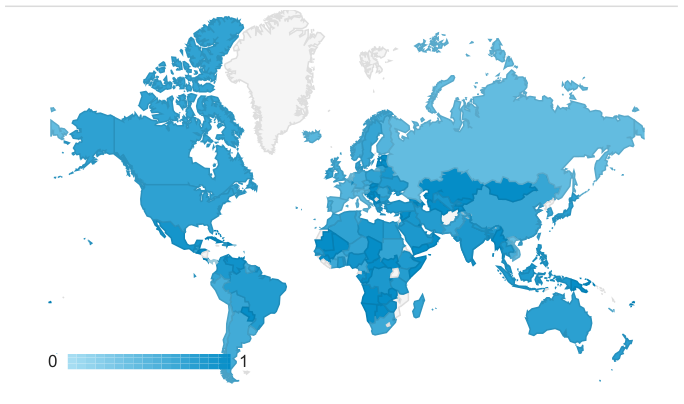
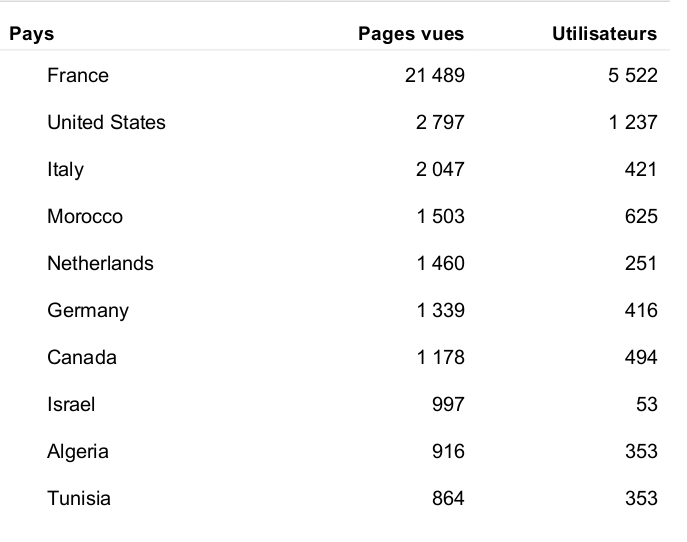
We will have several topics to comment for this blog that starts its third year, with a large audience : it received 23000 visits, and 47000 pages were read, a 50 % increase compared to last year. These weeks, it is getting harder for me to maintain a rhythm of a post per week that I tried to keep in the first two years. Contributions of data users are welcome !
 |  |
|
In white, the countries from which no visit was observed in 2014 (Ouganda, Afghanistan) |
Liste of the 10 countries from which the most frequent visits are observed. |