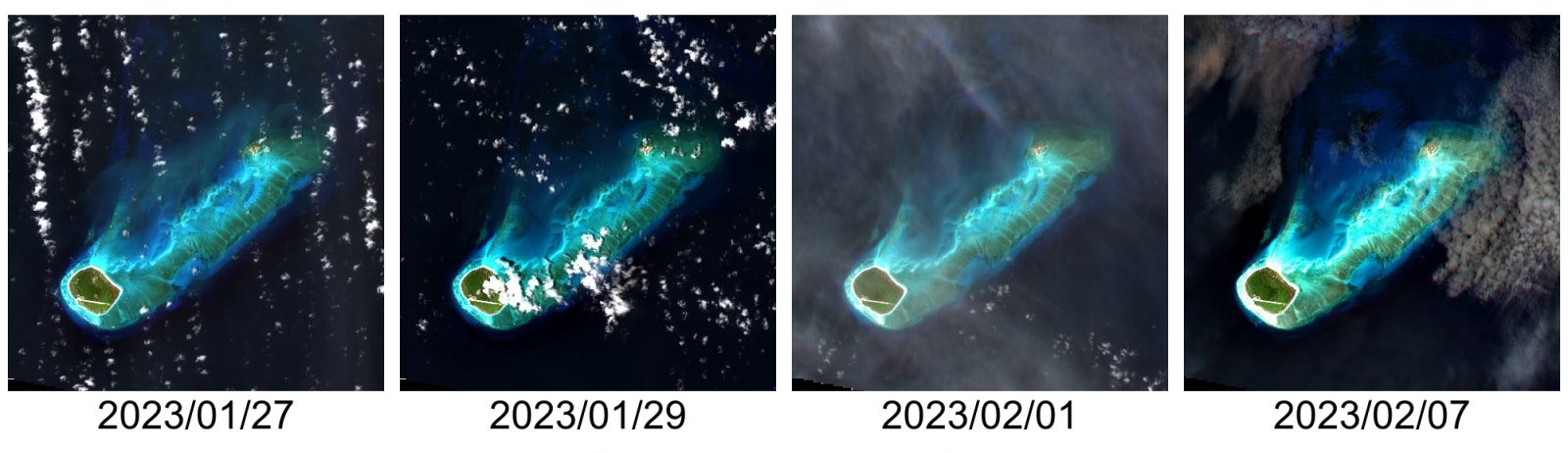
[VENµS] production of VM5 images restarts

We have had to cancel the production of VENµS L1C and L2A products for one month, because the footprints of VENµS images tend to change more than anticipated. The ground segment recognizes the sites by the coordinates of the corners, and the tolerances were not large enough. This problem has been understood and corrected by the VENµS team, and they managed to finally restart the production this week. The products are available from the CNES distribution site of Theia.

VENµS most recent products from the catalogue (screen copy on the 17th of March).

The level 1C (Orthorectified TOA reflectances) , and Level 2A (Surface reflectances with a cloud mask) are now produced with a short delay. We still need to fine tune some parameters for sites with a large snow cover. The L2A production has not started yet for some sites, as the level 2A production only starts when 8 L1C products are available (and L1C products are only produced when the images are cloud free).

We are very sorry for this difficult start of production, and apologize to our users who are waiting for the data. We now expect to have a much steadier production in the coming weeks.


 

Plus d'actualités

The missing link to valorize CESBIO’s applicative research works

=>  My colleagues at CESBIO are extremely creative! Over the past ten years, they have developed a wide range of new products and methods for extracting information from Copernicus data. They don’t just develop and validate the method on a few sites; they continue their work until they have produced data for the whole of […]

Le chaînon manquant dans la valorisation des travaux de recherche en télédétection

=> Mes collègues du CESBIO sont très créatifs ! Ils ont mis au point, au cours des dix dernières années, un grand nombre de nouveaux produits et de méthodes d’extraction de l’information à partir des données Copernicus (Sentinel-1 et 2). Et bien souvent, ils ne s’arrêtent pas à la mise au point de la méthode […]

Sentinel-2 overtakes Landsat in scientific litterature

OpenAlex is a new, yet already very useful, open database for exploring scientific literature. For an upcoming blog post on the CNES Datacampus website, I analysed the proportion of papers that used only one of the Sentinel-2 or Landsat missions, as well as those that used both, in 2025. What struck me was that Sentinel-2 […]

Rechercher