Sentinel-2 overtakes Landsat in scientific litterature
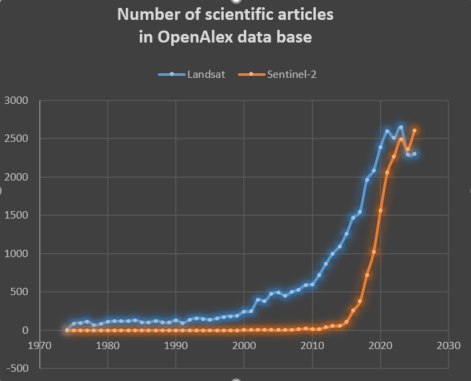
OpenAlex is a new, yet already very useful, open database for exploring scientific literature. For an upcoming blog post on the CNES Datacampus website, I analysed the proportion of papers that used only one of the Sentinel-2 or Landsat missions, as well as those that used both, in 2025. What struck me was that Sentinel-2 had just overtaken Landsat in terms of the number of papers!
To do that, I used the following requests :
https://openalex.org/works?page=1&filter=title_and_abstract.search:Landsat+and+Satellite
https://openalex.org/works?page=1&filter=title_and_abstract.search:Sentinel-2+and+Satellite
I had first omitted to search for the « satellite » keyword, but figured out that dozens of papers on both earth observation missions had been published before 1970, and that other experiments must have had the same names. Adding « Satellite » probably removes some genuine papers about these two fantastic missions, but even without that keyword, Sentinel-2 was still ahead of Landsat in 2025.
Landsat has been the reference earth observing satellite since the 70’s, and the cumulated number of publications is still the double of Sentinel-2, but what an achievement it is for Europe and the Copernicus Program in just 9 years !