In Lamasquère, ROSAS has produced its first rosaces


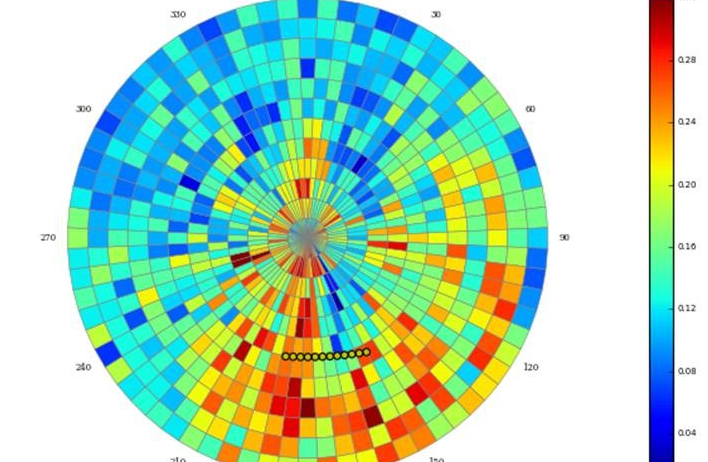
These space engineers are fast and efficient ! Just a week after our ROSAS station in Lamasquère was erected, we already have the first BRDF measurements, the producing of which required also the processing of calibration sequences. This was done thanks to our colleagues at CNES from the service in charge of measurement physics in optics, especially Lucas Landier, Sebastien Marcq and Aimé Meygret, and the exploitation team (Nicolas Guilleminot). Although the installation of the system has degraded the uniformity of the existing cover crop, the orders of magnitude of reflectances are as expected; and we can even see the shadow of the mast in the 120° azimuth direction in the top-left graph.

Let’s wait for the corn to be sown, and we should have much cleaner BRDFs.
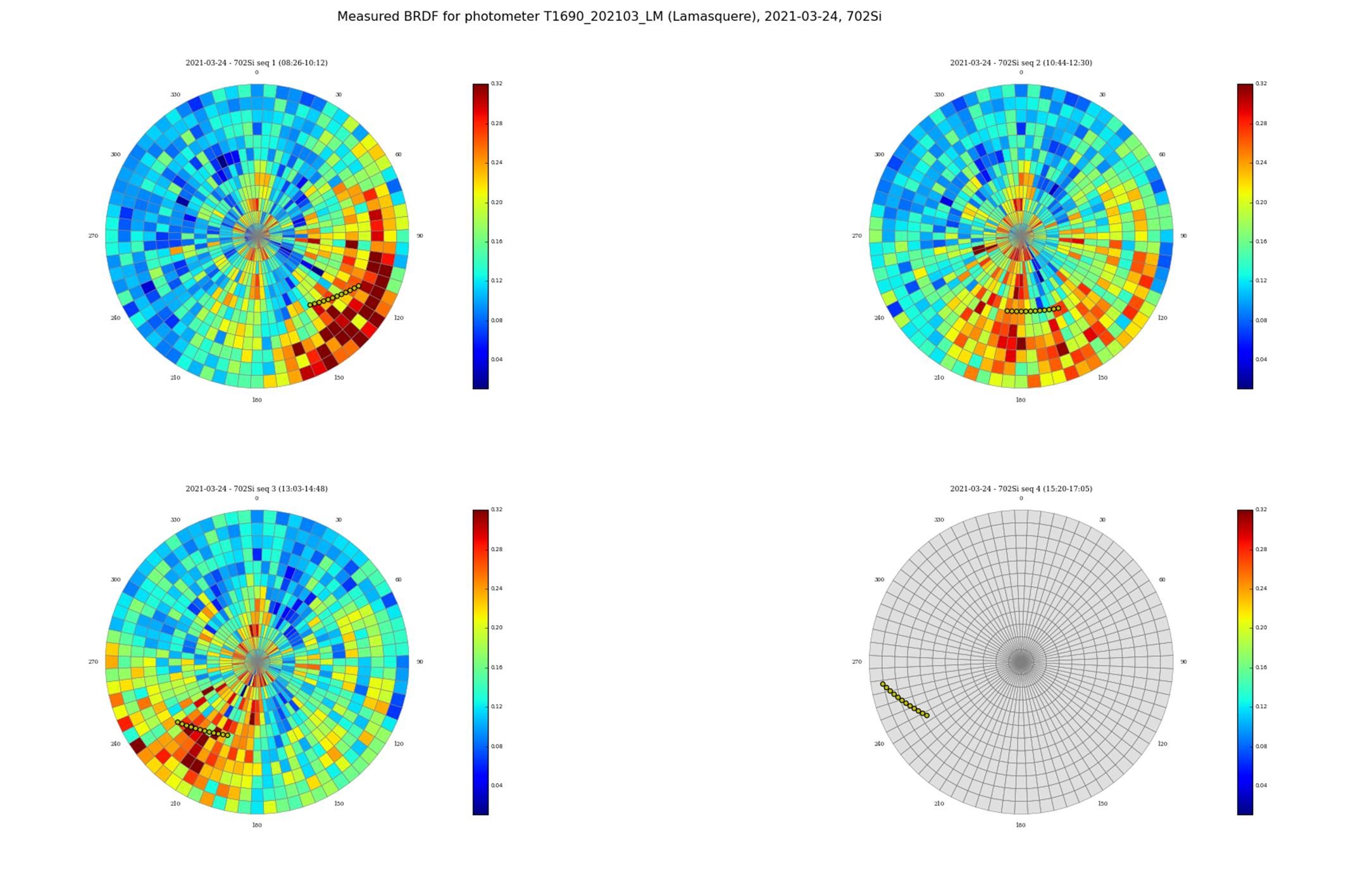
 

Polar diagrams of surface reflectances measured by our ROSAS station in Lamasquère. In this not very intuitive representation, the 0° azimut corresponds to observations towards the South.  The top left image was taken in the morning, the top right around noon, bottom left in the afternoon, and bottom right later on after the arrival of clouds. The yellow dots indicate the position of the sun. The radius of the graph corresponds to the zenith angle, and the other dimension is the azimuth with regard to the North.


Plus d'actualités

New clear-sky image of the Rasuwa rock-ice avalanche

On 08 Sep 2026, Sentinel-2 acquired a clear-sky image near the release area of the landslide which caused the catastrophic flood in Nepal. Using this image and a pre-event digital elevation model (Berthier 2026) we can analyze the upper part of the avalanche runout profile. The block of rock and ice was released near 5120 […]

How long is the cooling effect of a cloud shadow ?

How long does it take for the cannon barrel to cool down after firing a shell ? Fernand Raynaud => This quote is from a famous old French funny sketch by Fernand Raynaud, which was based on a question in a French manual for soldiers: the sketch is rather long, so I’ll give you the […]

Impact of the August 12, 2026 eclipse on photovoltaic electricity generation in Spain

Photovoltaic (PV) energy supplies more 20% of Spain’s total electricity, and this share hit a new high in July 2026 (28.3% of the nation’s monthly electricity mix). Some media outlets were concerned about the drop in photovoltaic power generation during the 12-Aug-2026 eclipse. Le Monde explained that « the drop is expected to be particularly pronounced […]

Rechercher