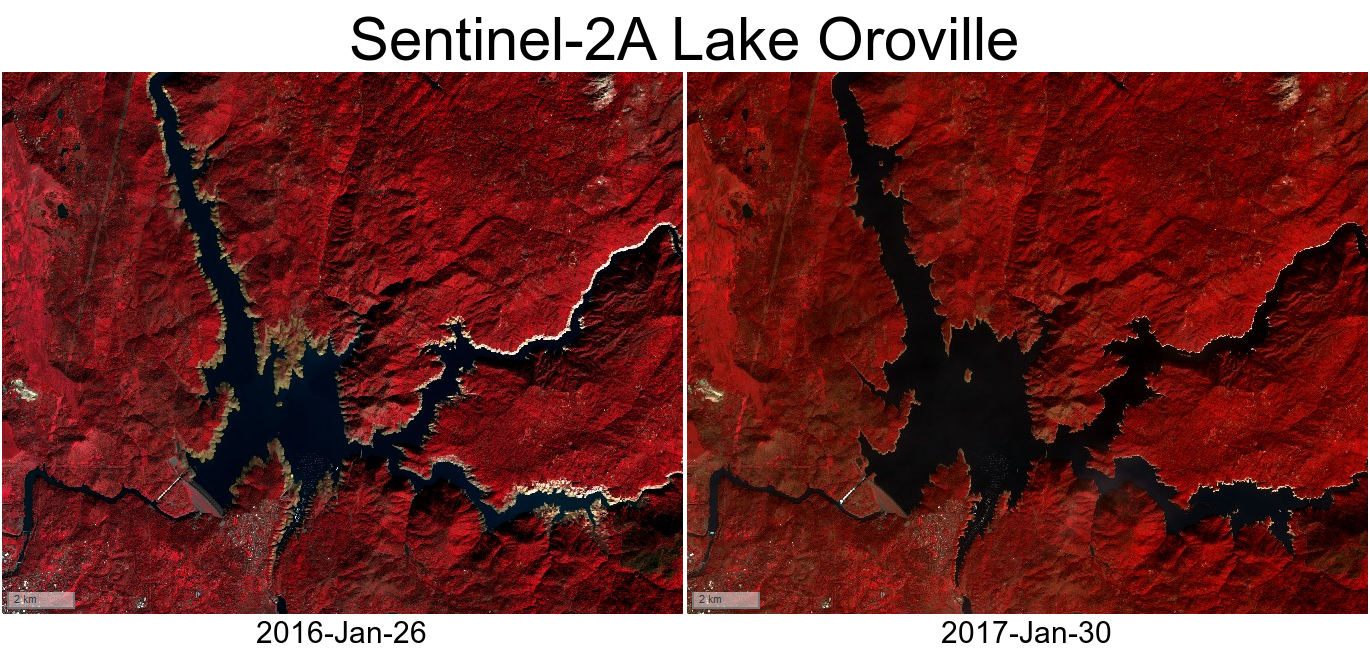
Lake Oroville in January 2016 vs. 2017

While California has just started to emerge from its worst drought in 1,200 years (2011-2016), it is now being hit by severe rainfalls, causing the evacuation of 188’000 northern California residents under the threat of spillway failure at Oroville Dam.


The Sentinel-2 mission began to monitor the western USA in 2016, so we can make an image comparison of the Lake Oroville in January 2016 (after five years of drought) and 2017 (after the heavy rainfalls). Here I used the NIR color composition (B8/B4/B3) in the Sentinel-Playground the highlight the contrast between the water and the vegetation surfaces.
As explained in this previous post, the normalized difference water index (NDWI) enables to better detect the lake extent.

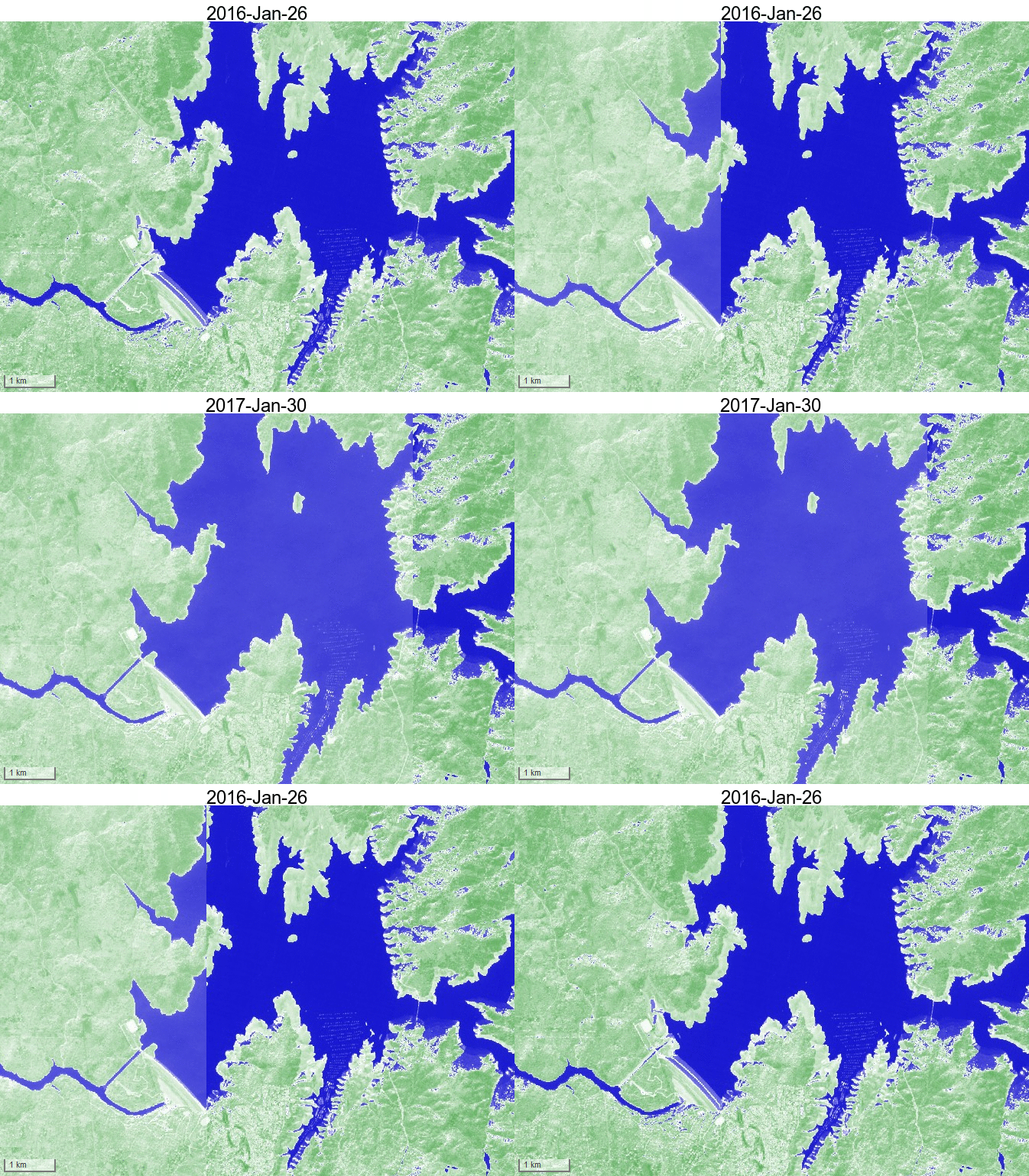
Here the NDWI is computed from level-1 images (top of the atmopshere reflectances). We can see that the water mask derived from the NDWI is not perfect in this mountainous region, as shaded (north-facing) slopes also have high NDWI values and can be confused with water surfaces. A better result could probably be achieved with level-2 images (top of canopy, flat surface reflectances).


Plus d'actualités

New clear-sky image of the Rasuwa rock-ice avalanche

On 08 Sep 2026, Sentinel-2 acquired a clear-sky image near the release area of the landslide which caused the catastrophic flood in Nepal. Using this image and a pre-event digital elevation model (Berthier 2026) we can analyze the upper part of the avalanche runout profile. The block of rock and ice was released near 5120 […]

How long is the cooling effect of a cloud shadow ?

How long does it take for the cannon barrel to cool down after firing a shell ? Fernand Raynaud => This quote is from a famous old French funny sketch by Fernand Raynaud, which was based on a question in a French manual for soldiers: the sketch is rather long, so I’ll give you the […]

Impact of the August 12, 2026 eclipse on photovoltaic electricity generation in Spain

Photovoltaic (PV) energy supplies more 20% of Spain’s total electricity, and this share hit a new high in July 2026 (28.3% of the nation’s monthly electricity mix). Some media outlets were concerned about the drop in photovoltaic power generation during the 12-Aug-2026 eclipse. Le Monde explained that « the drop is expected to be particularly pronounced […]

Rechercher