irrigation

The missing link to valorize CESBIO’s applicative research works

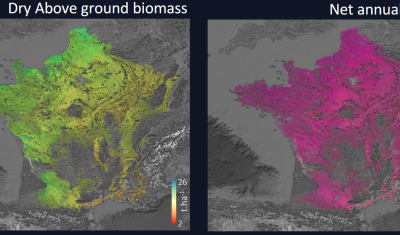
=>  My colleagues at CESBIO are extremely creative! Over the past ten years, they have developed a wide range of new products and methods for extracting information from Copernicus data. They don’t just develop and validate the method on a few sites; they continue their work until they have produced data for the whole of […]
23.02.2026

Le chaînon manquant dans la valorisation des travaux de recherche en télédétection

=> Mes collègues du CESBIO sont très créatifs ! Ils ont mis au point, au cours des dix dernières années, un grand nombre de nouveaux produits et de méthodes d’extraction de l’information à partir des données Copernicus (Sentinel-1 et 2). Et bien souvent, ils ne s’arrêtent pas à la mise au point de la méthode […]

Satellite Stereoscopy for Water Resource Monitoring?

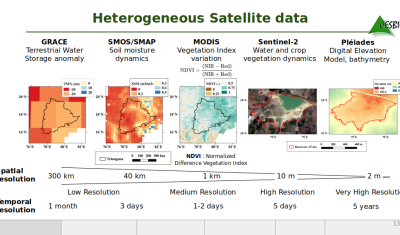
=> In arid or semi-arid regions, where irrigation is widespread, monitoring agricultural water resources is essential to anticipate shortages. These resources may come from large dams, small reservoirs, or groundwater aquifers. This is the case in the state of Telangana, in South India, where numerous large dams (shown in cyan blue in the figure below) […]

19.02.2025

La stéréoscopie par satellite pour le suivi des ressources en eau ?

=> Dans les régions arides ou semi-arides, où l’irrigation est généralisée, le suivi de la ressource en eau agricole est primordial pour anticiper les pénuries. Cette ressource peut-être l’eau de grands barrages, de petits réservoirs ou provenant de l’aquifère. C’est le cas de l’état du Télangana, en Inde du Sud, où de nombreux grands barrages […]

12.02.2025

SapienSapienS et le CNES nous expliquent l’observation de la terre

Le CNES a confié à la société SapienSapienS la réalisation de belles vidéos pour le grand public, qui expliquent de manière très didactique, et en moins de 5 minutes, différentes thématiques d’observation de la terre. Trois d’entre-elles font la part belle aux travaux du CESBIO, et je suis très fier d’avoir contribué à la première […]

28.02.2024

Global map of irrigated areas

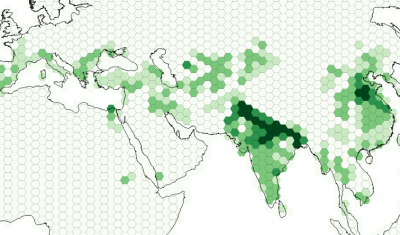
It’s not easy to find a good cartographic representation of the global irrigated land, therefore I made my own map using data from Meier et al. (2018). The raw resolution of the above product is 30 arcsec, i.e. 1 pixel covers about 1 km by 1 km at equator. Here, I aim to represent the […]

01.08.2023

Feedback on hydrological monitoring of Telangana region in India using remote sensing

=> Claire Pascal, PhD student at CESBIO, under the supervision of Olivier Merlin (CNRS researcher) and Sylvain Ferrant (IRD researcher) brilliantly defended her thesis on the monitoring of water resources by satellite on November 18. Claire’s work focused on the Telangana region of India where rainfed cotton and flooded rice farming dominate. The region has […]

01.12.2022

Les bassines de Boudnib

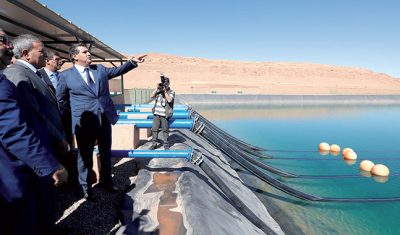
Alors que les bassines se développent en France pour stocker l’eau en particulier en Pays de la Loire, elles sont aussi utilisées au Maroc dans un environnement bien plus aride. Dans la région désertique entre Errachidia et Boudnib, près de la frontière algérienne, l’apparition de ces piscines géantes a transformé le paysage. L’eau est prélevée […]

18.05.2022

Crop Irrigation, a new project labeled by the Space Climate Observatory

=>  The Space Climate Observatory (SCO) is an international initiative of the One Planet Summit, launched in June 2019, which is also a French initiative. The SCO brings together several space agencies around the world and international organizations (UNDP, ESA, UNEP). It aims at developping projects for local decision-makers to help them adapt to climate […]

20.01.2021

Rechercher