
 =>
=> 
Since its launch in August 2018, the Franco-Israeli Venµs pushbroom satellite has been affected by attitude restitution noise that hinders the registration of the 12 spectral bands and of time series of images. The efforts made during flight acceptance tests have significantly improved the geometric quality of the images to make them usable. However, this correction is insufficient for 20% of the images produced.
In order to solve this problem, a new attitude estimation method has been developed. VENµS successively acquires images in 12 spectral bands between 390 and 950 nm. By exploiting sub-pixel deformation measurements of 3 images corresponding to 3 spectral bands whose acquisition is shifted by 2.8s, we obtain attitude information with an angular accuracy and time frequency which is much higher than those of VENµS’ AOCS (Attitude and Orbit Control Systems) equipment. The accuracy achieved on the satellite’s attitude is 20 times greater than that of the AOCS, and 10 times greater than the correction implemented in the initial processing chains of the VENµS mission.
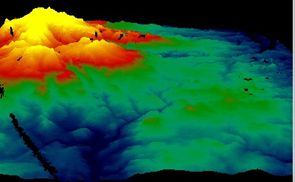
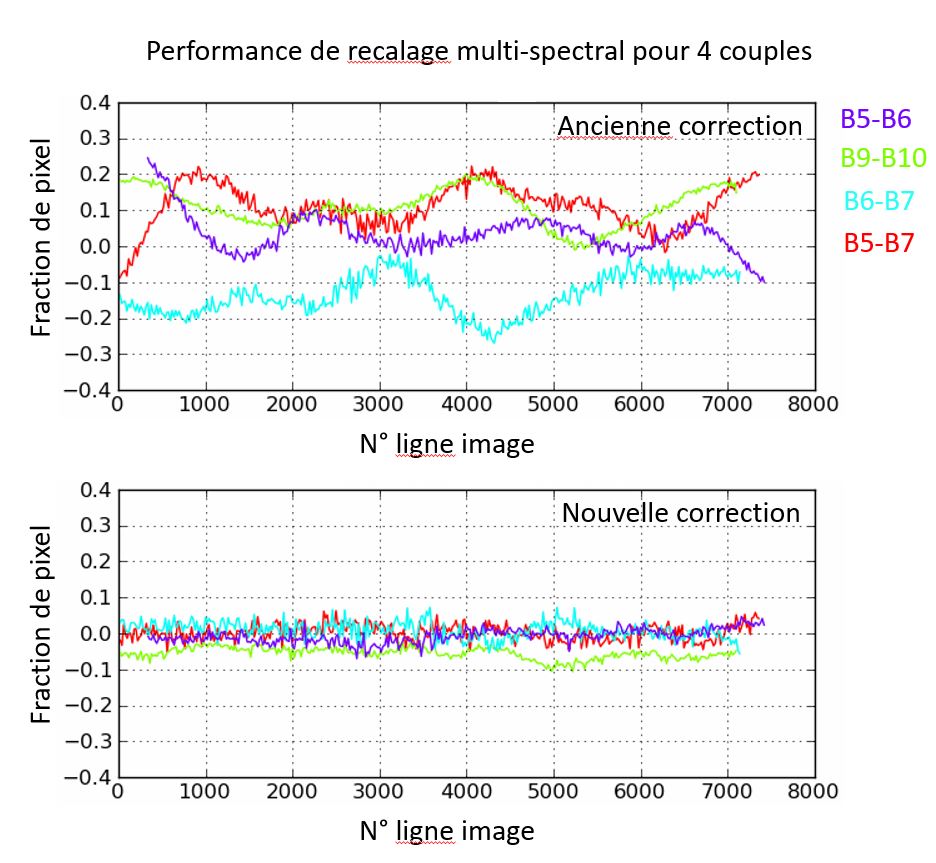
The figure illustrates the improvement in superposition over 4 pairs of spectral bands. The residual overlay error is 0.05 pixel maximum. This unparalleled accuracy opens the way to new applications that require a registration quality that exceeds the specifications of 0.1. These new applications include the creation of Digital Terrain Models, which exploit the native stereoscopy capability of the focal plane, and coastal zone bathymetry (a study at LEGOS laboratory is in progress) which exploits the time delays of the spectral bands on the swell.