[VENµS] How long will the VM5 imaging phase last ? The sun will decide
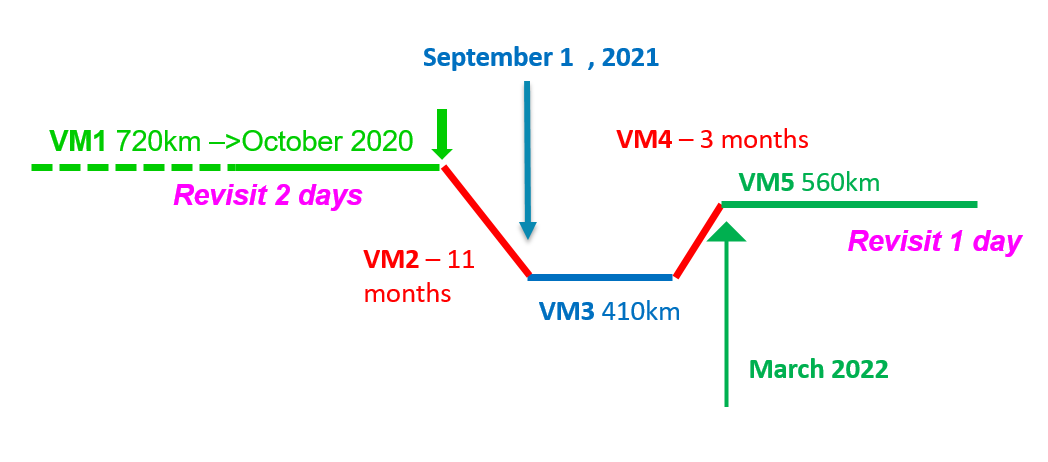
The VENµS satellite was launched in August 2017, with two missions :
- observing the earth with a frequent revisit and a high resolution, under constant view angles
- testing an electric propulsion system to change its orbit, and to show the possibility to maitain the spacecraft orbit at a very low altitude.
As a result, VENµS has had different phases separated by orbital changes. It’s imaging phases are VM1 at 720 km altitude, which lasted for three years, and the current VM5 phase at 560 km altitude, which started in March 2022.
So, what will be the duration of the VM5 phase ? The sun will decide !
The main limiting factor is indeed the quantity of propellant within the satellite. VENµS has a limited amount of propellant in its tank, and at 560 km altitude, the satellite is still a bit slowed down by the atmospheric friction, which itself depends on the solar activity. The propellant is used to maintain the speed and height of the satellite, and in some time, we will run out of propellant.
The more sun activity, the more atmospheric friction. We are now near the maximum of the sun activity, and our Israeli colleagues who control the VENµS platform gave us the following estimates :
- If average activity is 75%, VM5 will last at least until May 2024
- If average activity is 50%, VM5 will last at least until December 2024
These estimates are minimum values as we have some uncertainty on the exact remaining quantity or propellant, so the minimum estimate was used. This is good news, it means that if the satellite health stays good, we still have more than one year of acquisitions ahead of us, and maybe two !

And finally, we do not need to save propellant for a deorbitation, as at the current altitude, if the orbit is not maintained, the deorbitation comes only after a few years (once again depending on solar activity).