
Watching ice shelves break up with Sentinel-1

The animation below shows the evolution of Thwaites glacier eastern ice shelf in West Antarctica, from July 2016 to May 2017. I made it with 45 quicklooks of Sentinel-1 radar images processed by the Alaska Satellite Facility and available via the vertex data portal. All images were acquired in interferometric wide swath mode (polarization HH, only ascending passes, path: 65, frame: 914) and projected to ground range.


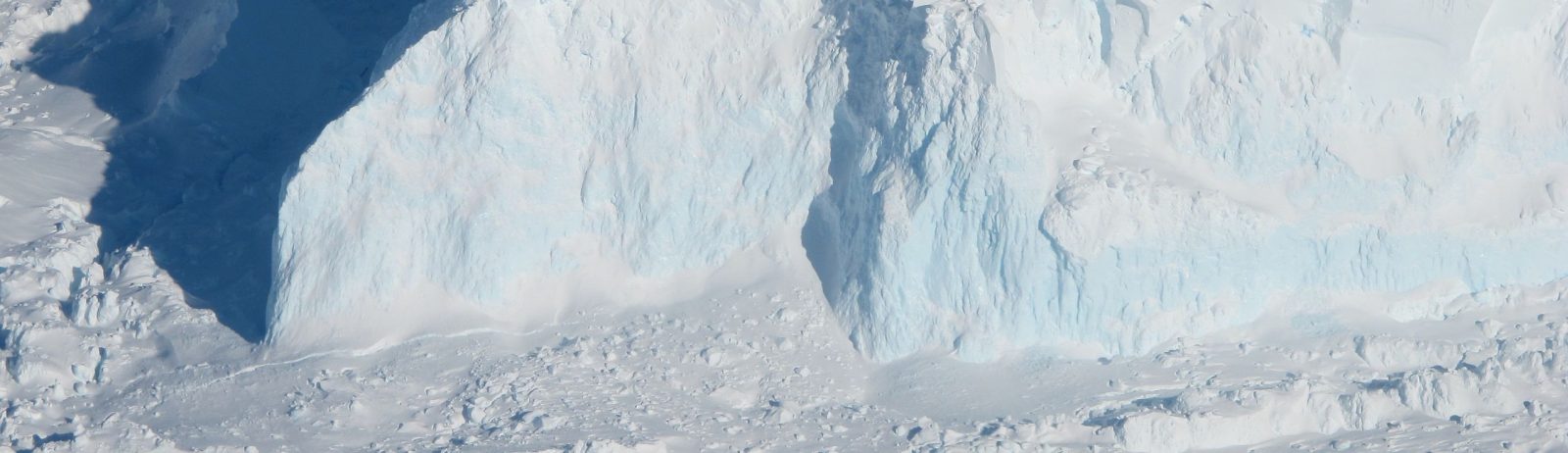
This area was imaged almost every 6 days by Sentinel-1A and Sentinel-1B with a constant observation angle. Radar imagery is important in polar regions to track icebergs during the polar night. In this sequence we can see many icebergs drifting in the Amundsen Sea. In April 2017, just before the winter onset, two big icebergs calved from the Thwaites ice shelf. Did you know that the U.S. National Ice Center (NIC) assigns a name to the largest Antarctic icebergs? According to the NIC tables I think these are iceberg B42 and B43. Iceberg B42 had a length of 17 nautical miles (31 km) in the update of May 19, 2017.
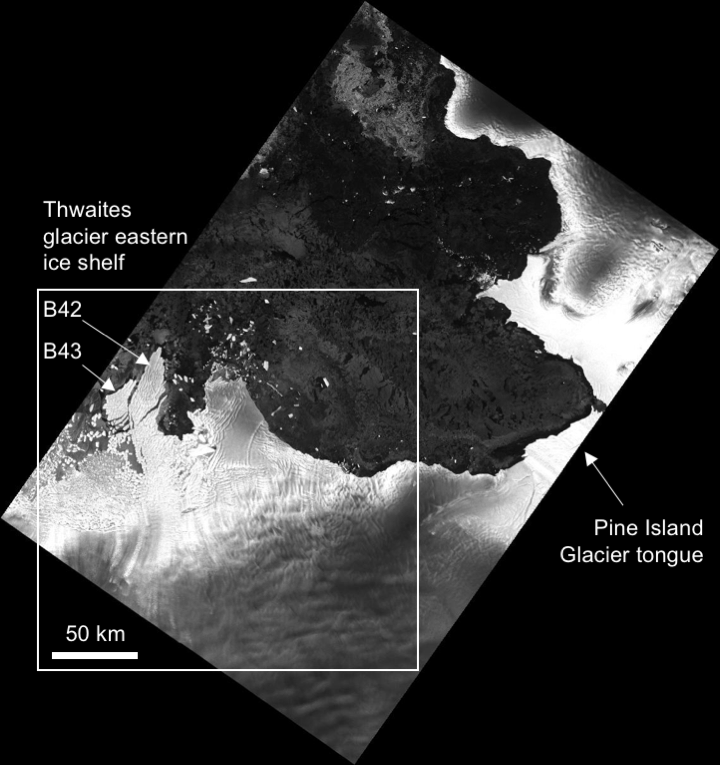
Sentinel-1B image acquired on 2017 Apr 03

(Edit on Oct 24, 2017) I extended the video to the period Feb 2015 to Sep 2017 (214 frames, this time I had to use Google Earth Engine) 


Plus d'actualités

Suivi du manteau neigeux dans les parcs naturels des Alpes franco-italiennes

Dans les Alpes, le manteau neigeux est un stock d’eau saisonnier naturel dont dépendent la faune, la flore et les humains pour de multiples usages (refuges, bétail, etc.). Dans le cadre du projet ACLIMO financé par le programme européen Interreg ALCOTRA, le Cesbio a été sollicité pour mettre en oeuvre un outil d’estimation de l’équivalent […]

The missing link to valorize CESBIO’s applicative research works

=>  My colleagues at CESBIO are extremely creative! Over the past ten years, they have developed a wide range of new products and methods for extracting information from Copernicus data. They don’t just develop and validate the method on a few sites; they continue their work until they have produced data for the whole of […]

Le chaînon manquant dans la valorisation des travaux de recherche en télédétection

=> Mes collègues du CESBIO sont très créatifs ! Ils ont mis au point, au cours des dix dernières années, un grand nombre de nouveaux produits et de méthodes d’extraction de l’information à partir des données Copernicus (Sentinel-1 et 2). Et bien souvent, ils ne s’arrêtent pas à la mise au point de la méthode […]

Rechercher