[VENµS news 2] Mission extension and next phases
About one year ago, we had submitted a call for ideas for the use of VENµS imager after the end of its nominal phase. CNES also organised a brain storming meeting, which came up with a few ideas, and then our proposals were discussed with our israeli partners. Here is what was agreed between CNES and the Israeli Space Agency :
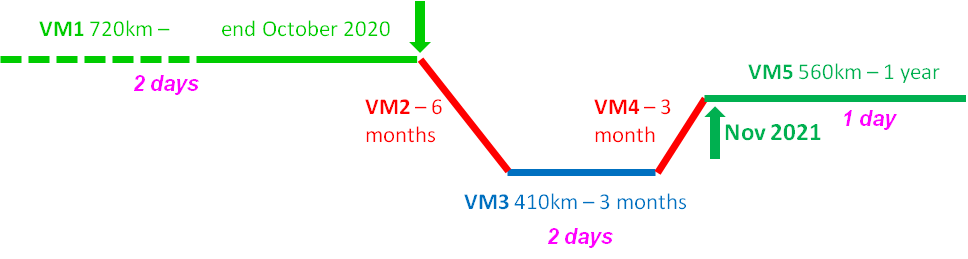
- VM1 extension: The current scientific imaging mission (VM1) will be extended from the initial date of August 31st, 2020 to the end of October 2020 in order to better cover the end of the main vegetation season in the Northern hemisphere.
=> Therefore the acquisitions will continue until October 2020 over the sites that are currently acquired.
- VM2 From November 2020, VENµS will go down from the altitude of 720 km to the altitude of 410 km. This phase (VM2) of lowering the orbit will take 6 months and will use the Israeli Hall Effect Thruster (IHET).
- VM3 The IHET will be used for 3 months to maintain the 410 km orbit, the revisit period is 2 days. During this phase, only a few images will be acquired for demonstration and technological purposes.
- VM4 Then VENµS will raise up to 560 km. The duration of this phase will be three months.
- VM5 VENµS will stay at 560 km (VM5) for at least 1 year from about November 2021 to November 2022, and hopefully more. On this orbit, the revisit period is one day, the overpass time will be mid-morning. However, not all the current scientific sites can be observed from this orbit. Therefore a new call of proposal for new sites will be issued in the coming weeks.
Clearly this plan is ambitious, but given the good health of the satellite, its « fuel » reserves and the skills of the teams we are confident we will achieve it.
In summary:
- extension of current acquisition until late October 2020, with 2 days revisit
- no image acquisition from November 2020 to November 2021 (except to check the health of the instrument)
- Images every day for scientists, starting from November 2021, for at least one year. But sites are to be renewed partially.