The end of VENµS imaging phase
 =>
=> 
It is with some sadness but also a lot of pride that I remind you that the VENµS operational phase will end at the end of July after 7 years of good work. The current acquisition phase (VM5) will stop on the 12th of July. The remaining weeks will be devoted to a few technical experiments (acquisitions over Israel will go on until end of July), and then, our Israeli colleagues will empty the tanks by lowering the orbit, passivate the satellite, and then let the higher layers of the atmosphere reduce its speed and lower its altitude before burning in the atmosphere in a few years.
The French and Israeli space agencies (CNES and ISA) launched the VENµS micro-satellite in August 2017, and for a micro-satellite, it has had quite a special life ! VENµS was first injected into orbit at 720 km altitude. It stayed there for 3 years (VENµS Mission 1 phase, VM1), then its orbit was lowered to 400 km (VM2), it was maintained there for a few months (VM3), before being raised again (VM4) to 560 km (VM5) where it stayed for two and a half years.
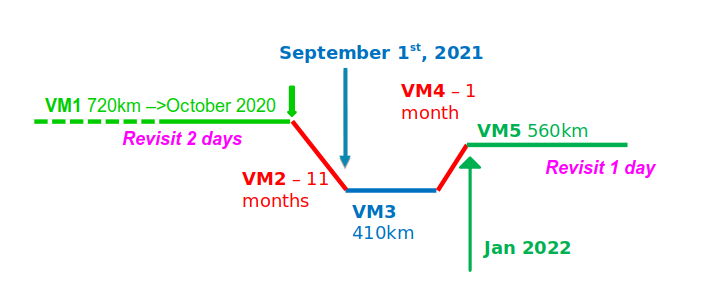
VENµS indeed had two missions :
- test a ionic propulsion engine and verify it was able to change orbits and even maintain the satellite at 400 km altitude with all the atmospheric drag due to the highest levels of the earth atmosphere
- take repetitive images of selected sites at a high resolution (4 to 5 m), frequent revisit (1 or 2 days), with 12 thin spectral bands, and a high-quality instrument
The two phases VM1 and VM5 were used to observe around 100 sites (different sites for each phase), with a revisit of two days during VM1, and one day for some sites during VM5. All the images have been processed to Level 1C and Level 2A. Regarding VM5, a full reprocessing will be done at the end of 2024 to have a consistent data set with the latest updated geometric and radiometric correction parameters, and the same updated versions of software during the whole life of VENµS. The same reprocessing had been done after the end of VM1 in 2022.
Although VENµS’ scientific impact was not as high as expected due to its late launch (VENµS was meant to demonstrate the power of multi-temporal optical observations, but was finally launched after Sentinel-2), it nevertheless incited us to prepare the arrival of Sentinel-2 observations intensively. The development of many methods such as those in MAJA, WASP, Iota2 or LIS processors were motivated by the existence of the VENµS project.
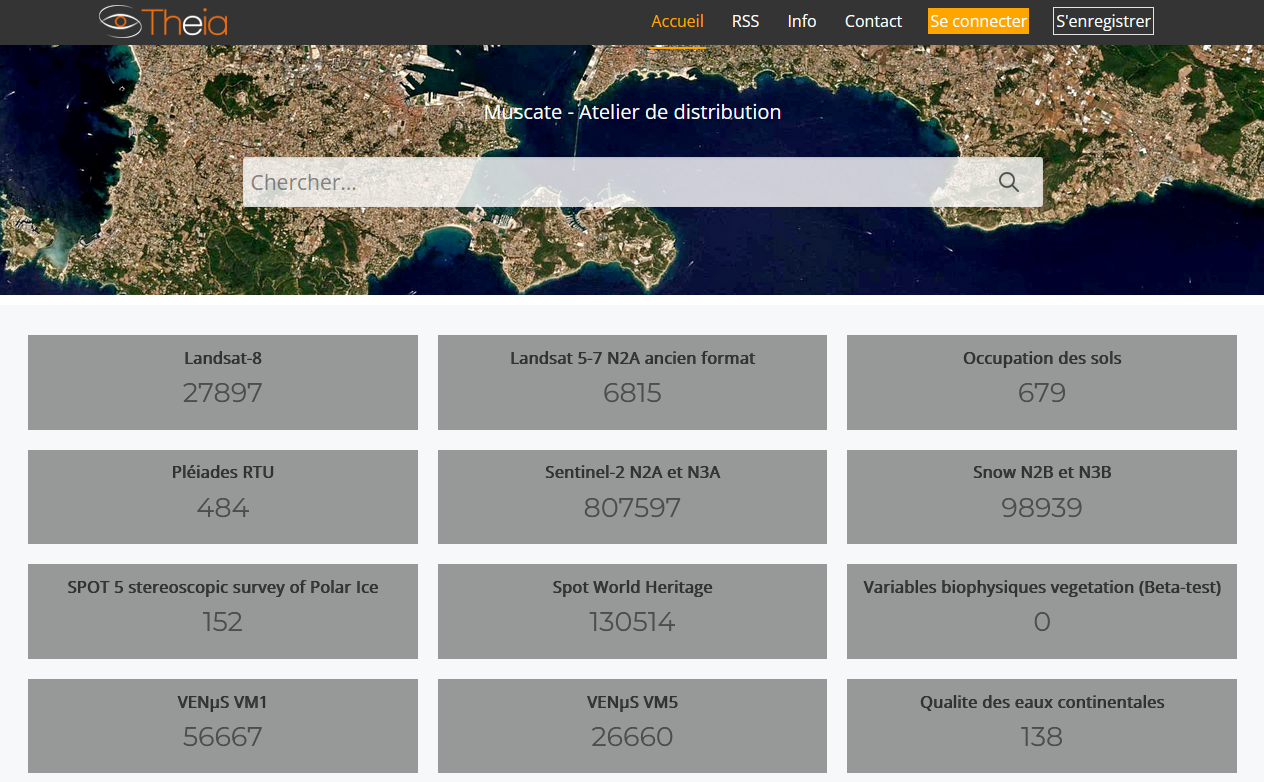
Moreover, the data acquired by VENµS are here to stay (https://theia.cnes.fr), and we hope its unique combination of resolution (4m) and revisit (1 day) with 12 bands, will still be useful for several years to come. Our little satellite is getting very well known in the deep learning community, as it has been used to build the Sen2VENµS data set for learning to improve the resolution of Sentinel-2, or to test data fusion methods between Sentinel-2 and VENµS.
With this post, we would like to thank all the teams in France and Israel who contributed to the decision, funding, building, exploitation and data processing of this satellite. The list of persons who brought a meaningful contribution would be too long (hundreds), and the risk of forgetting someone will to too high, so we will only cite Gerard Dedieu and Arnon Karnieli, the initial French and Israeli PIs (Arnon is still PI), who devoted many years of their career to the success of this little satellite.
Written by VENµS PI: Olivier Hagolle (CNES/CESBIO) with the help of Arnon Karnieli (BGU)
PS : The end of VM5 was a difficult period with an aging satellite that was well over its nominal life of 3 tears with a goal set to 5 years. A non-negligible proportion of the attempted acquisitions failed, and some sites did not yield the expected time series. We apologize if the data collection was not as good as your expectations. However, our data collection includes more than 82,000 products, 56,000 for VM1, and 26,000 for VM5, bringing much analysis-ready data