
Snowmelt and snow sublimation in the Indus basin

The Indus basin has one of the largest irrigation system in the world. Available water resources are abstracted almost entirely, mostly for crop irrigation in Pakistan.

The Indus basin is also considered as one of the large basins in Asia with the highest dependence on snowmelt runoff.
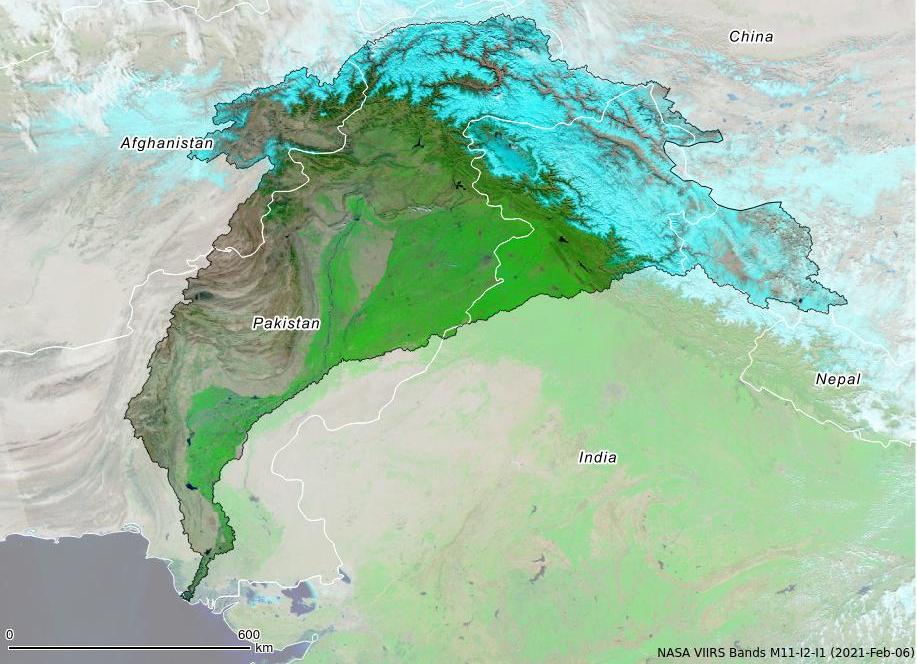
VIIRS false color image of the Indus basin (irrigated areas in green, snow cover in blue)

The contribution of snow and ice melt to runoff in the Indus basin was already well studied [1,2,3] but a pending question was how much water is lost by sublimation of the snow cover in the high mountain regions of the basin?

I used the recent High Mountain Asia snow reanalysis to re-evaluate snowmelt and estimate snow sublimation at the scale of the Indus basin.
Image
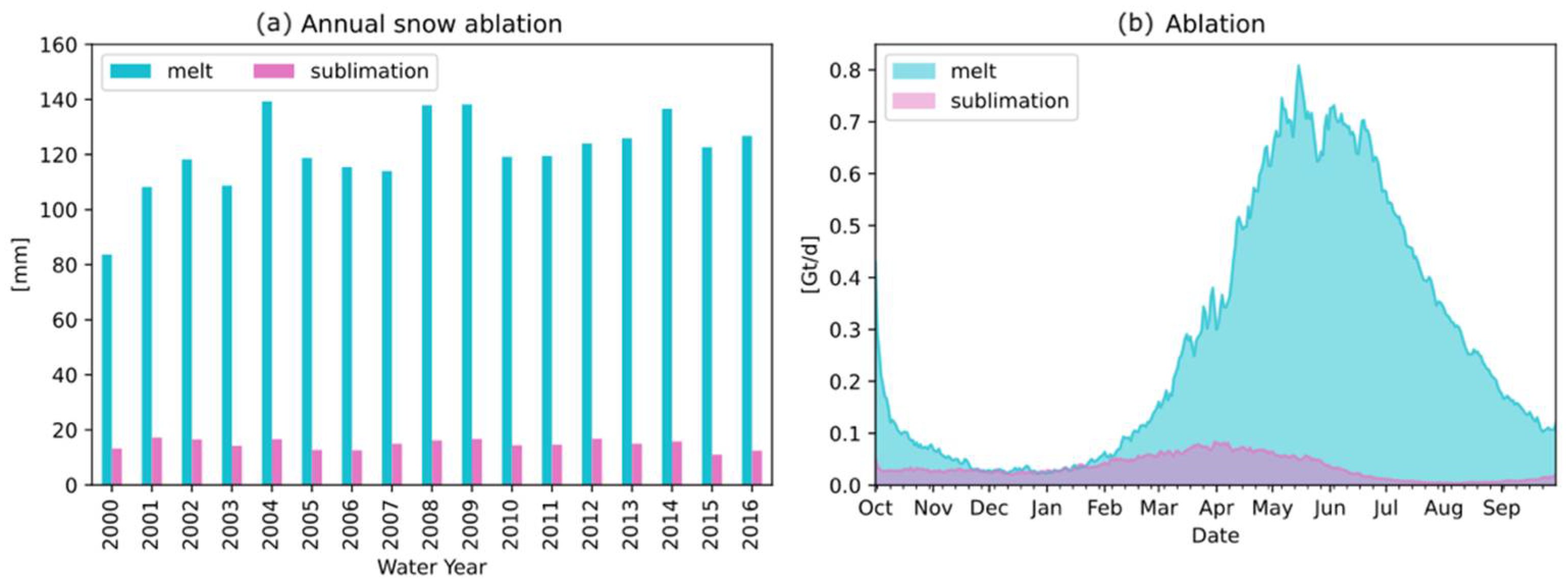
Snowmelt and sublimation in the Indus basin. Timeseries of annual snowmelt and sublimation (a) and timeseries of the mean daily snowmelt and sublimation (b).

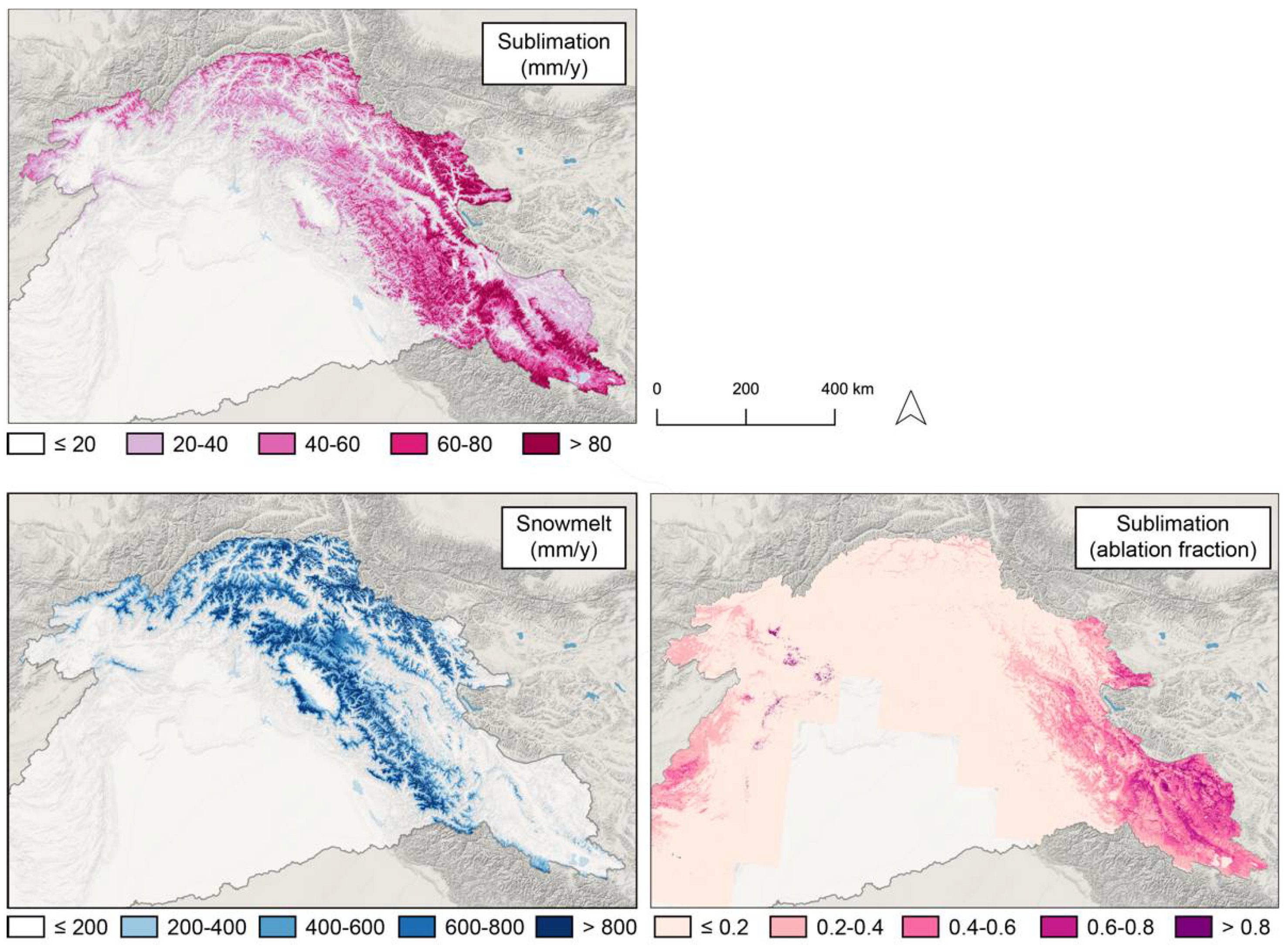
Over 2000–2016, snowmelt was about 25–30% of basin-average annual precipitation. About 11% of the snowfall was « lost » by sublimation, but with a large spatial variability across the basin. Sublimation fraction can be much higher in the arid regions in Ladakh and Western Tibet.
Image

For this study I challenged myself to follow best practices in open science. I only used open data and the code to reproduce the study is available online. It was fun!

Paper: mdpi.com/2073-4441/13/1

Dataset: nsidc.org/data/HMA_SR_D/

Code: https://github.com/sgascoin/HMA-Snow-Reanalysis-scripts/

Many thanks to the authors High Mountain Asia snow reanalysis for sharing this amazing dataset!

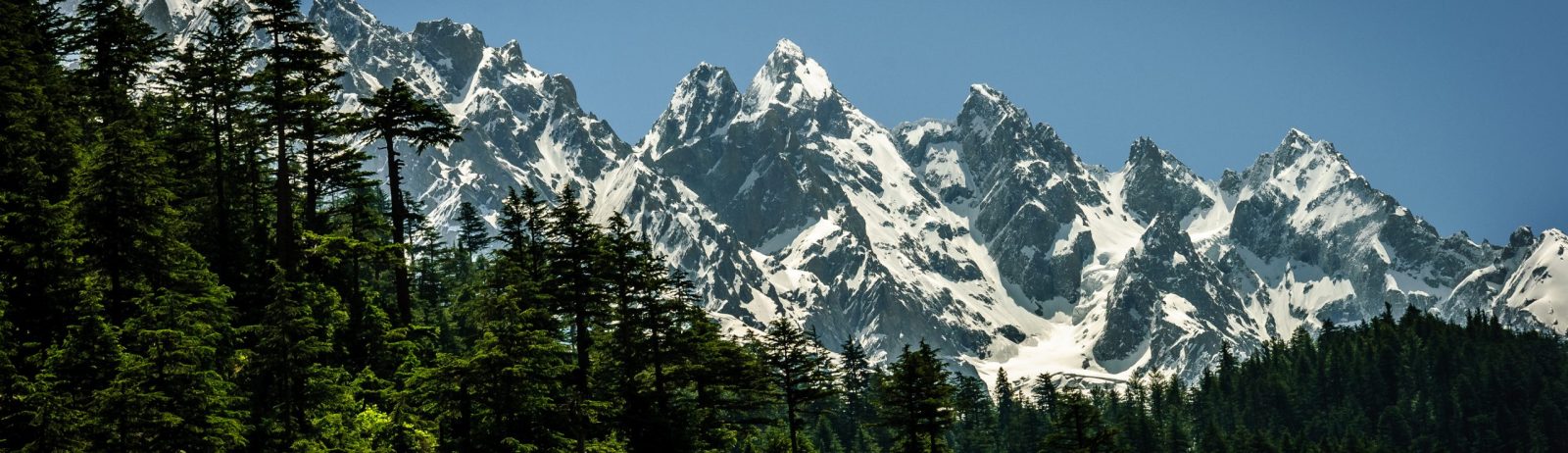
Top picture: Mountains in Swat Valley Pakistan (by Designer429, CC BY-SA 3.0, via Wikimedia Commons)

 

Plus d'actualités

Near real time snow cover maps in the Copernicus Browser!

Copernicus provides near real time snow cover maps at 20 m resolution (fractional snow cover, code name: FSC OG). These products have been recently reprocessed and are now available through the Copernicus Data Space Ecosystem (CDSE) API and visualization tool, the Copernicus Browser! The latter is very useful to explore the data, for example if […]

Suivi du manteau neigeux dans les parcs naturels des Alpes franco-italiennes

Dans les Alpes, le manteau neigeux est un stock d’eau saisonnier naturel dont dépendent la faune, la flore et les humains pour de multiples usages (refuges, bétail, etc.). Dans le cadre du projet ACLIMO financé par le programme européen Interreg ALCOTRA, le Cesbio a été sollicité pour mettre en oeuvre un outil d’estimation de l’équivalent […]

The missing link to valorize CESBIO’s applicative research works

=>  My colleagues at CESBIO are extremely creative! Over the past ten years, they have developed a wide range of new products and methods for extracting information from Copernicus data. They don’t just develop and validate the method on a few sites; they continue their work until they have produced data for the whole of […]

Rechercher