
Release of SPOT (Take5) L1C data

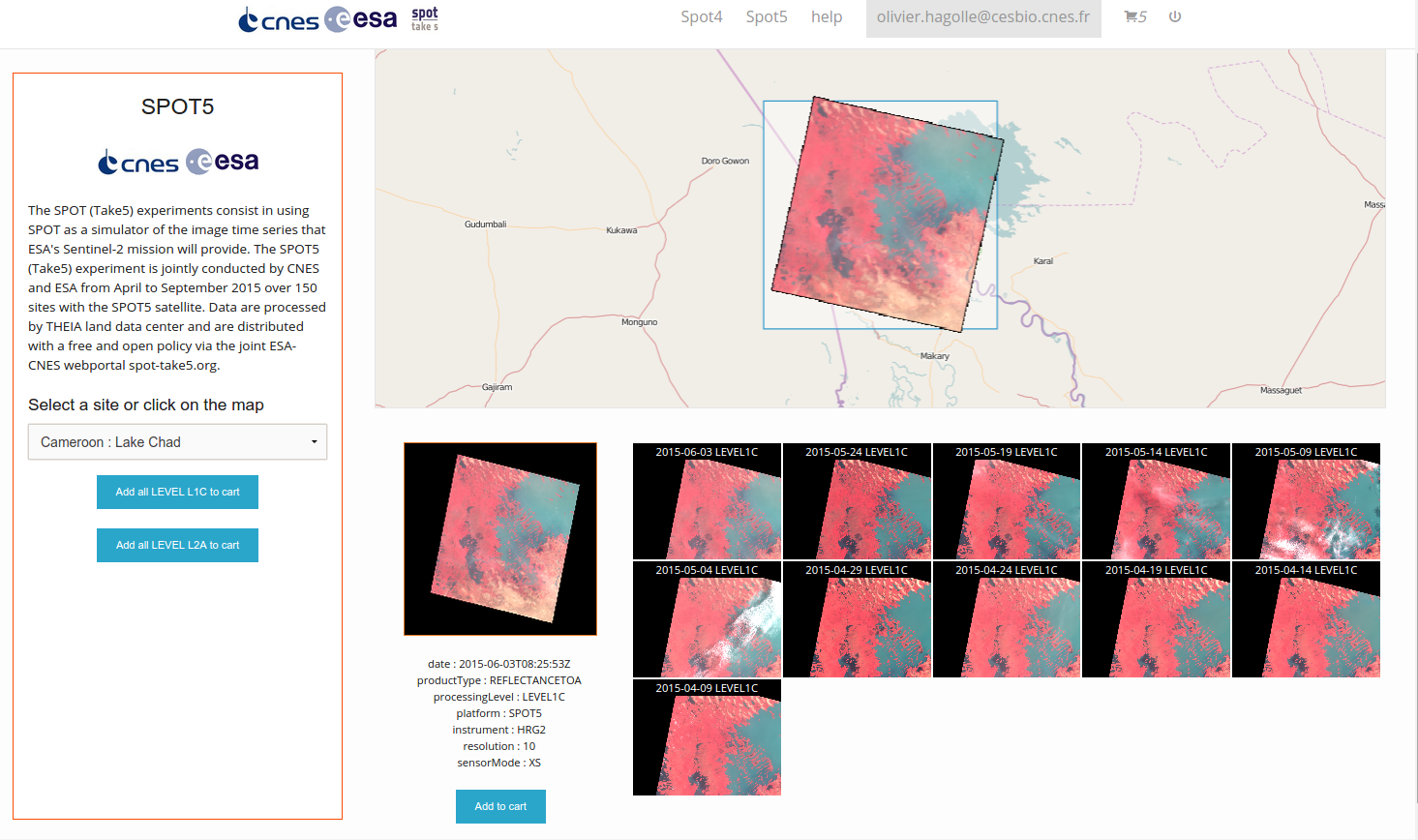
The SPOT5 (Take5) L1C data acquired before the 3rd of June have just been uploaded to

https://spot-take5.org

If you are interested in atmospherically corrected data, with a good cloud mask, please wait for a few more days, as the level 2A production of the same data is also ready and being prepared for upload to the server too. The file format for both Level 1C and Level 2A is available here.Some explanations on how the the distribution server works is available here.This achievement is the result of the hard work of many at CNES, CESBIO, ESA, whom I already quoted in this blog, but this last stage was done by the MUSCATE TEAM at CNES, among which I would like to thank Karl Rodriguez and Patrick di Giovanni (both from Steria company) for their great work.
Plus d'actualités

The missing link to valorize CESBIO’s applicative research works

=>  My colleagues at CESBIO are extremely creative! Over the past ten years, they have developed a wide range of new products and methods for extracting information from Copernicus data. They don’t just develop and validate the method on a few sites; they continue their work until they have produced data for the whole of […]

Sentinel-2 overtakes Landsat in scientific litterature

OpenAlex is a new, yet already very useful, open database for exploring scientific literature. For an upcoming blog post on the CNES Datacampus website, I analysed the proportion of papers that used only one of the Sentinel-2 or Landsat missions, as well as those that used both, in 2025. What struck me was that Sentinel-2 […]

IOTA2 software mailing list

Hello everyone, We have just created a mailing list for users of the IOTA2 software (iota2 — iota2 documentation). The tool will undergo significant developments in the coming months, and the purpose of this list is to communicate with the community to support these changes and to maintain the processing workflows needed by the users. […]

Rechercher