
Global sea ice area : a scary plot

When I say « a scary plot », I don’t mean a Chinese plot aimed at confusing some naive North Americans, it just mean a figure (an American one, by the way, made with data from the National Snow and Ice Data Center) that provides the total sea ice area over the globe. And this figure is scary :
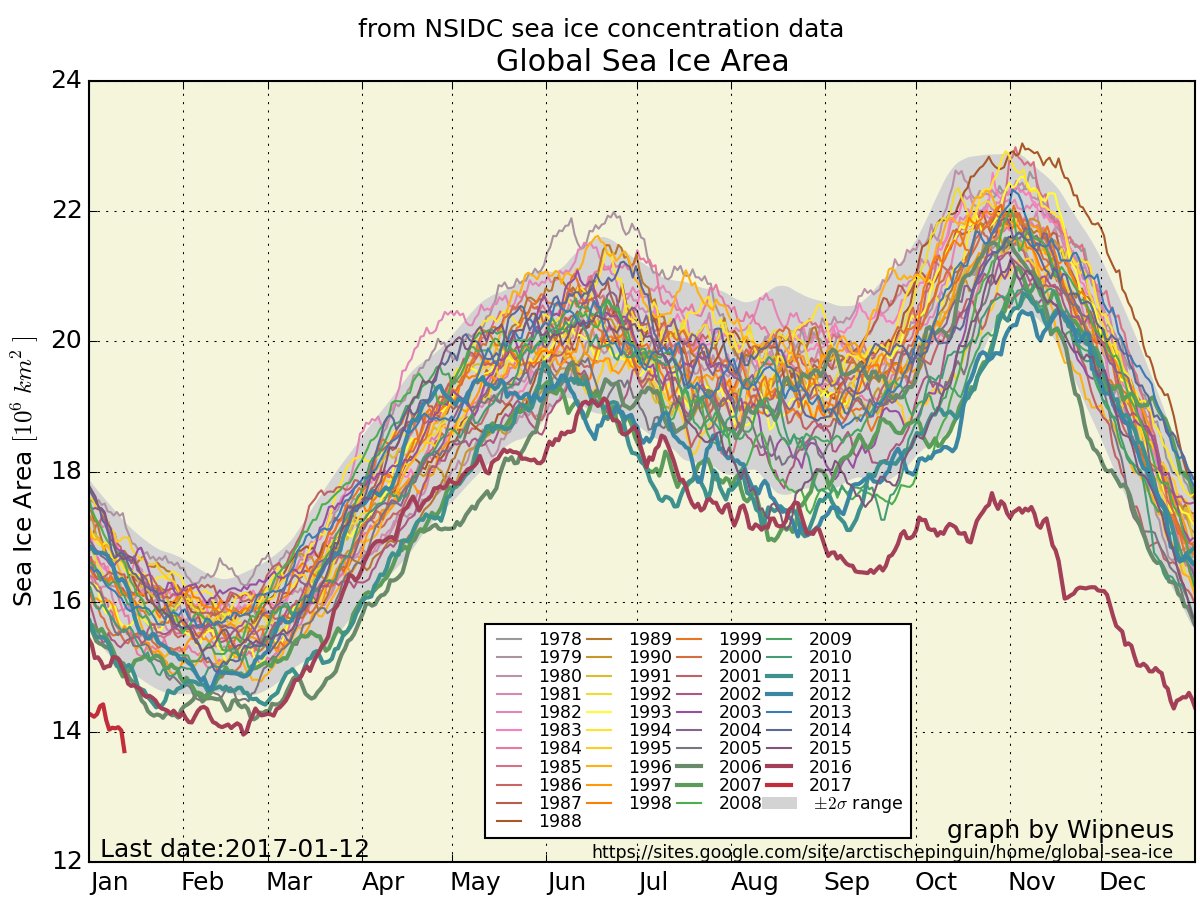
The red curve corresponds to last year’s sea ice area.

Let’s hope it is partly due to the el-niño phenomenon we had last year, and that next years will come closer to the average curves. However, as a cold wave is about to reach western Europe, let’s record it for later !


Plus d'actualités

Near real time snow cover maps in the Copernicus Browser!

Copernicus provides near real time snow cover maps at 20 m resolution (fractional snow cover, code name: FSC OG). These products have been recently reprocessed and are now available through the Copernicus Data Space Ecosystem (CDSE) API and visualization tool, the Copernicus Browser! The latter is very useful to explore the data, for example if […]

Suivi du manteau neigeux dans les parcs naturels des Alpes franco-italiennes

Dans les Alpes, le manteau neigeux est un stock d’eau saisonnier naturel dont dépendent la faune, la flore et les humains pour de multiples usages (refuges, bétail, etc.). Dans le cadre du projet ACLIMO financé par le programme européen Interreg ALCOTRA, le Cesbio a été sollicité pour mettre en oeuvre un outil d’estimation de l’équivalent […]

The missing link to valorize CESBIO’s applicative research works

=>  My colleagues at CESBIO are extremely creative! Over the past ten years, they have developed a wide range of new products and methods for extracting information from Copernicus data. They don’t just develop and validate the method on a few sites; they continue their work until they have produced data for the whole of […]

Rechercher