Autumn snow drought on Mount Damavand

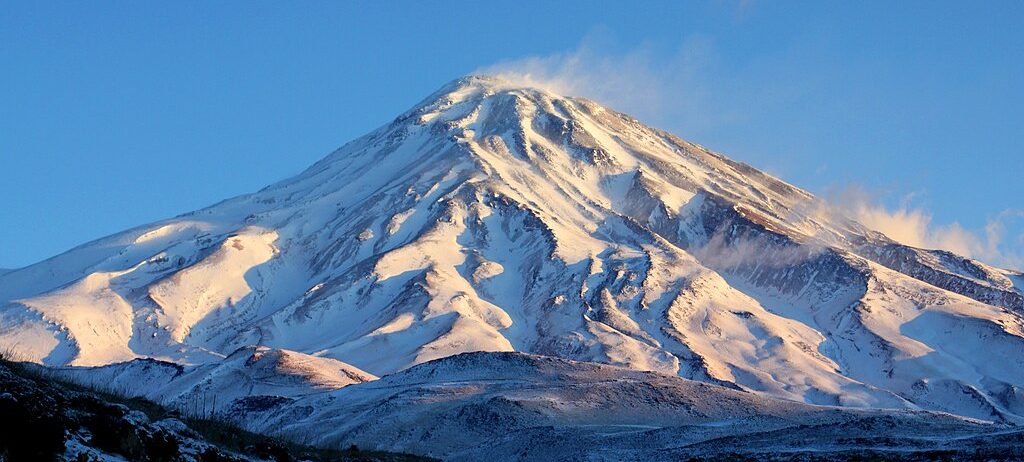
« We are currently experiencing the driest autumn the country has experienced in 50 years » said Iran’s meteorological organisation. Near Tehran, Mount Damavand, the highest peak in Iran (5609 m) was reported to be « unusually bare of snow ».

I checked this statement using my MODIS snow cover data processing algorithm implemented in Google Earth Engine (Gascoin et al. 2022).

The data confirm that the snow cover area around Mount Damavand was well below the normal since September 2025. The snow cover area was nearly zero until mid November when finally a snowfall occurred! However, it probably fell only a few centimeters of snow. On 19 November 2025, a Sentinel-2 image shows that the snow cover was already gone on the south facing slope of Mount Damavand and the snow line elevation was near 3500 m in the north facing shaded areas.

Sentinel-2 image on 19 Nov 2025. Elevation contours in green.

Let’s hope that more snow will come soon to alleviate the unprecedented drought that Iran is currently facing.

Photo header credit: Safa.daneshvar, CC BY-SA 4.0 https://creativecommons.org/licenses/by-sa/4.0, via Wikimedia Commons


Plus d'actualités

Suivi du manteau neigeux dans les parcs naturels des Alpes franco-italiennes

Dans les Alpes, le manteau neigeux est un stock d’eau saisonnier naturel dont dépendent la faune, la flore et les humains pour de multiples usages (refuges, bétail, etc.). Dans le cadre du projet ACLIMO financé par le programme européen Interreg ALCOTRA, le Cesbio a été sollicité pour mettre en oeuvre un outil d’estimation de l’équivalent […]

The missing link to valorize CESBIO’s applicative research works

=>  My colleagues at CESBIO are extremely creative! Over the past ten years, they have developed a wide range of new products and methods for extracting information from Copernicus data. They don’t just develop and validate the method on a few sites; they continue their work until they have produced data for the whole of […]

Le chaînon manquant dans la valorisation des travaux de recherche en télédétection

=> Mes collègues du CESBIO sont très créatifs ! Ils ont mis au point, au cours des dix dernières années, un grand nombre de nouveaux produits et de méthodes d’extraction de l’information à partir des données Copernicus (Sentinel-1 et 2). Et bien souvent, ils ne s’arrêtent pas à la mise au point de la méthode […]

Rechercher