Autumn snow drought on Mount Damavand

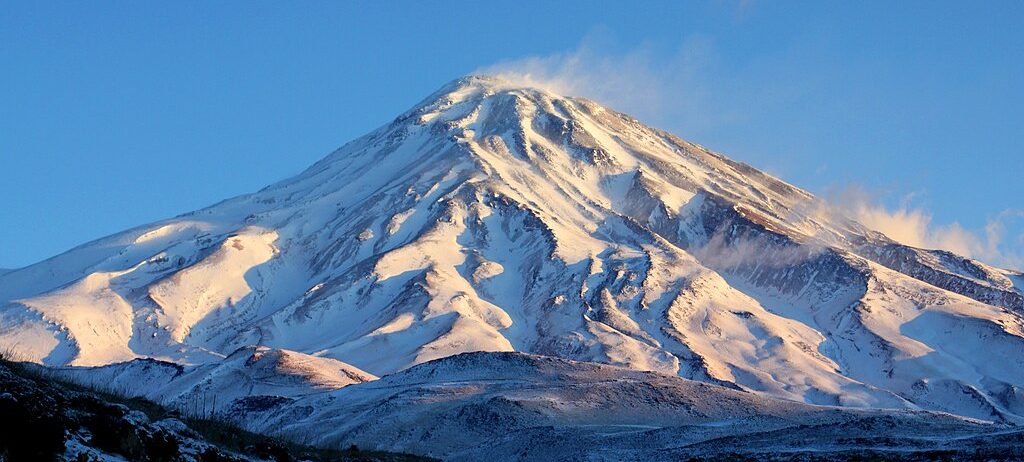
« We are currently experiencing the driest autumn the country has experienced in 50 years » said Iran’s meteorological organisation. Near Tehran, Mount Damavand, the highest peak in Iran (5609 m) was reported to be « unusually bare of snow ».

I checked this statement using my MODIS snow cover data processing algorithm implemented in Google Earth Engine (Gascoin et al. 2022).

The data confirm that the snow cover area around Mount Damavand was well below the normal since September 2025. The snow cover area was nearly zero until mid November when finally a snowfall occurred! However, it probably fell only a few centimeters of snow. On 19 November 2025, a Sentinel-2 image shows that the snow cover was already gone on the south facing slope of Mount Damavand and the snow line elevation was near 3500 m in the north facing shaded areas.

Sentinel-2 image on 19 Nov 2025. Elevation contours in green.

Let’s hope that more snow will come soon to alleviate the unprecedented drought that Iran is currently facing.

Photo header credit: Safa.daneshvar, CC BY-SA 4.0 https://creativecommons.org/licenses/by-sa/4.0, via Wikimedia Commons


Plus d'actualités

Three Sentinel-2 satellites instead of two: impact on the retrieval of the snow disappearance date

Due to the success of Olivier’s petition, ESA kept Sentinel-2A operational after the launch of Sentinel-2C. Having three operational satellites instead of two increases the revisit, which should improve the quality of the derived products, and therefore the reliability of operational services based on Sentinel-2 data. One of this service is the Copernicus’ High Resolution […]

Evolution des glaciers du Vignemale sous l’œil des satellites Pléiades (2013-2025)

Grâce à DINAMIS, un couple d’images stéréoscopiques a été acquis par Pléiades 1B le 14 septembre 2025. Le modèle numérique de surface (MNS) produit à partir de ces images peut être comparé à un autre MNS de septembre 2013 produit à partir des images Pléiades 1A commandées par Marti et al. (2014). Le glacier d’Ossoue […]

Évolution du jour de déneigement dans les Alpes françaises et les Pyrénées

Les socio-écosystèmes des Alpes et des Pyrénées dépendent étroitement des fluctuations annuelles du manteau neigeux. En particulier, le moment de l’année où la neige disparait détermine le début de la saison de croissance de la végétation de montagne et donc la période des estives. Le changement climatique est en train de bouleverser ce rythme saisonnier. […]

Rechercher